


What is a lipo-abdominoplasty?
Lipo-abdominoplasty is a tummy tuck performed together with liposuction of the upper abdomen, waist and flanks, using a technique that deliberately lifts as little tissue as possible. It removes loose lower abdominal skin, repairs separated muscles and reshapes the waist in one operation.
Why it is called a Brazilian tummy tuck
The technique was described by the Brazilian plastic surgeon Osvaldo Saldanha and colleagues, who published “Lipoabdominoplasty without undermining” in the Aesthetic Surgery Journal in 2001. It became widely known as the Saldanha technique, and in the UK and elsewhere it is often marketed as a “Brazilian tummy tuck”.
How it differs from a classic tummy tuck
In a classic abdominoplasty, the skin and fat of the abdomen are lifted off the muscles all the way up to the ribs. This cuts through many of the small blood vessels (perforators), lymphatic channels and nerves that pass up through the muscle into the skin. Because the lifted skin then relies on a reduced blood supply, surgeons traditionally limit how much liposuction they do at the same time.
In lipo-abdominoplasty the surgeon:
- uses liposuction to thin and shape the upper abdomen, waist and flanks;
- lifts only a narrow central tunnel above the belly button, enough to repair the muscles, leaving the perforating vessels at the sides intact;
- removes the lower skin and fat, often preserving a thin deep layer of tissue over the muscles that carries lymphatic channels;
- draws the loosened skin down and repositions the belly button.
The aim is a more natural waist curve than a tummy tuck alone, with better blood supply to the skin and less dead space for fluid to collect in. Surgeons who use the technique report lower seroma rates than with classic abdominoplasty, although much of the evidence comes from case series rather than randomised trials.
It is not a Brazilian butt lift (BBL)
The names are easily confused, but they are different operations. A Brazilian butt lift takes fat by liposuction and injects it into the buttocks. A Brazilian tummy tuck treats the abdomen and waist and does not involve transferring fat to the buttocks. The specific risks of injecting fat into the buttock region do not apply to lipo-abdominoplasty. Because the term is used loosely, always ask any clinic exactly which operation, and which areas, a “Brazilian tummy tuck” quote includes.
Surgery is for adults (18+). It is not a weight-loss operation, and suitability is decided at consultation with the surgeon who would operate.
Who is it suitable for?
Lipo-abdominoplasty usually suits adults at a stable weight who have loose skin on the lower abdomen and also carry fat on the upper abdomen, waist or flanks that has not shifted with diet and exercise.
You may be a good candidate if you:
- have loose or overhanging skin below the belly button, often after pregnancy or weight loss;
- have fat around the waist and “love handles” as well as at the front;
- have separated stomach muscles (diastasis recti) that physiotherapy has not closed;
- have been at a steady weight for at least 6–12 months, ideally with a BMI in a healthy or modestly raised range;
- do not smoke, or can stop smoking and nicotine (including vapes and patches) at least 6 weeks before and after surgery.
It may not be the right choice if you have little fat and mainly loose skin (a full tummy tuck may be enough), if you have fat but firm skin (liposuction alone may be enough), or if you have lost a very large amount of weight and have loose skin in both directions or all the way round (see fleur-de-lis abdominoplasty and lower body lift).
If you are still losing weight, including with GLP-1 medicines such as semaglutide or tirzepatide, it is usually better to reach a stable weight first, and to tell your surgeon and anaesthetist about these medicines. If you plan more pregnancies, most surgeons advise waiting.
How it compares with other tummy tucks
Lipo-abdominoplasty sits between a classic tummy tuck and larger body-contouring operations. The right choice depends on your skin, fat, muscle and priorities for scarring and recovery.
Lipo-abdominoplasty (Brazilian tummy tuck)
Tummy tuck plus liposuction of the upper abdomen, waist and flanks, with limited tissue lifting. Hip-to-hip scar and belly button scar. Priced by the number of liposuction areas.
Lipo-abdominoplastyFull tummy tuck
Removes loose lower skin and repairs the muscles, with wider lifting of the skin and less liposuction. Suits loose skin without much waist fat.
Tummy tuckMini tummy tuck
Treats only below the belly button with a shorter scar. Does not address the waist or upper abdomen.
Mini tummy tuckFleur-de-lis abdominoplasty
Adds a vertical midline scar to remove loose skin from side to side. Mainly after massive weight loss.
Fleur-de-lis tummy tuckLiposuction alone
Removes fat through small incisions but does not remove skin or repair muscle.
LiposuctionWhat happens during surgery
Lipo-abdominoplasty is performed under general anaesthetic and usually takes 3–4 hours, depending on how many areas are treated.
Before the day
Your operating surgeon examines you standing and lying, assesses your skin, fat and muscle, and agrees with you which liposuction areas to treat. You can complete the Silhouette™ questionnaire before your first appointment, and your records are held in the Adoreal patient portal. After at least 14 days’ reflection you confirm your consent; further consultations are always available. You will be asked to stop smoking and nicotine (including vapes and patches) at least 6 weeks before and after surgery, and may need blood tests.
At iQonic, lipo-abdominoplasty is performed by our consultant plastic surgeons, a consultant plastic surgeon who trained in Italy, Brazil, Taiwan and Japan and whose practice focuses on body contouring. You can read more on our surgeons page.
On the day
- Markings. Your surgeon marks the liposuction areas and the scar line with you standing.
- Tumescent infiltration. A fluid containing dilute local anaesthetic and adrenaline is infiltrated to reduce bleeding and help the liposuction.
- Liposuction. Fat is removed from the upper abdomen, waist, flanks and any other agreed areas through small incisions, thinning the tissue so it can move down more freely.
- Limited lifting and muscle repair. The lower skin is removed and only a narrow central tunnel is lifted above the belly button, through which the separated muscles are stitched together.
- Belly button and closure. The skin is drawn down, the belly button is brought out through a new opening, and the wound is closed in layers.
- Compression. Dressings and a compression garment are applied. Drains may or may not be used.
Compression stockings and calf pumps are used during surgery, and you may be given blood-thinning injections afterwards depending on your risk assessment.
Recovery, week by week
Recovery is similar to a full tummy tuck, with added bruising and swelling in the liposuction areas. Most people return to desk work in 3–4 weeks, and to full exercise at around 3 months.
- Days 1–3
You will feel tight across the abdomen and bruised around the waist. You walk slightly bent forward, with regular pain relief and short walks. Liposuction incisions may leak blood-stained fluid, which is expected.
- Week 1
At home, resting with regular short walks. Wear your compression garment day and night. Sleep with your head and knees raised. A wound check is arranged.
- Weeks 2–3
You stand straighter and bruising fades. Keep walking regularly, and avoid lifting, including young children.
- Weeks 3–6
Many people return to desk work at 3–4 weeks. Driving is usually possible at a similar time, once you can wear a seatbelt and brake hard comfortably. Garment wear usually continues to about 6 weeks. Gentle exercise such as walking or a static bike can restart.
- 3 months
Most swelling has settled. Core exercise and heavier lifting are reintroduced gradually once your surgeon is happy. Some firmness or lumpiness in liposuction areas can persist.
- 6–12 months
The final waist contour is established and the scar continues to fade over 12–18 months.
When to call us
Contact the clinic if you notice rapid or one-sided swelling, spreading redness, discharge, a temperature of 38°C or above, or dark or blistered skin near the wound. Call 999 for chest pain or sudden breathlessness, and seek urgent help for a painful, swollen calf. Avoid long-haul flights for around 6 weeks.
Results and how long they last
You will see a flatter abdomen and a narrower waist straight away, though swelling hides the final contour for 3–6 months and it continues to refine for up to a year. Results are long-lasting as long as your weight stays stable.
- Loose lower skin and most stretch marks below the belly button are removed.
- Separated muscles are repaired.
- The waist and flanks are reshaped by liposuction, which a tummy tuck alone does not address.
Fat cells removed by liposuction do not return, but the remaining fat cells can enlarge with weight gain, sometimes unevenly. Fat inside the abdomen, around the organs, is not affected by surgery. Future pregnancy can stretch the skin and muscle repair again. You can see examples on our before and after page; results vary between people.
Before and after
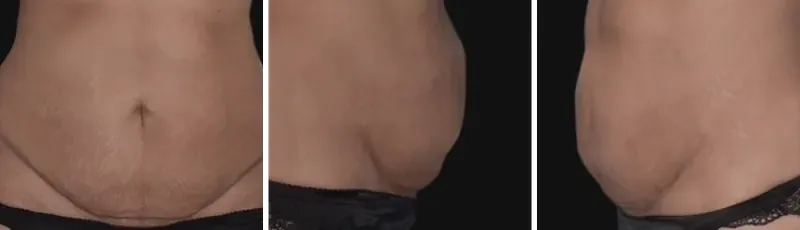
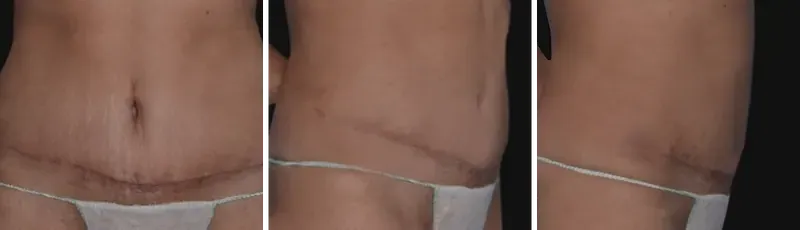
Clinical photographs
These images show surgical results and include nudity. They are for adults considering surgery.
Risks and possible complications
Lipo-abdominoplasty carries the risks of both a tummy tuck and liposuction. Combining procedures lengthens surgery and increases some risks: in a US database study of 25,478 abdominoplasties, the major complication rate was 3.8% when a tummy tuck was combined with liposuction, rising to 10.4% when liposuction and other body-contouring operations were added.
- Seroma: fluid under the skin, usually drained with a needle in clinic
- Bleeding or haematoma
- Wound infection
- Delayed wound healing or wound breakdown, most often at the centre of the scar
- Skin or fat necrosis, much more likely in smokers
- Blood clots in the legs (DVT) or lungs (pulmonary embolism)
- Contour irregularities, dimpling or asymmetry in liposuction areas
- Numbness of the lower abdomen, which usually improves over 12–18 months but may be partly permanent
- Wide, raised or keloid scars
- Belly button problems, including poor shape or narrowing
- Fluid shifts and, rarely, local anaesthetic toxicity or fat embolism related to liposuction
- Risks of general anaesthetic
- Unsatisfactory cosmetic result, sometimes needing further surgery
How risk is reduced
Stopping smoking and nicotine (including vapes and patches) at least 6 weeks before and after surgery and being at a stable weight make the biggest difference to wound healing. The limited lifting in this technique is intended to protect the skin’s blood supply. Joint UK guidance from BAAPS and BAPRAS recommends limits on the amount of fat removed in one operation, extra caution when large-volume liposuction is combined with other procedures, and post-operative monitoring when more than 1 litre is removed under general anaesthetic; ask your surgeon how your plan fits within it.
Your surgeon and anaesthetist will assess your clotting risk and plan fluids, compression and early mobilisation. If you want several areas treated, they may suggest staging procedures rather than doing everything at once. Ask how complications and any revision surgery would be handled and charged. Under iQonic’s terms, a request for revision must be made in writing within 12 months of your operation, and any agreed revision must take place within 18 months.
Alternatives to consider
The main alternatives are a classic full tummy tuck, liposuction alone, a mini tummy tuck, or separate operations at different times. The choice depends on how much waist fat you have relative to loose skin.
- Full tummy tuck if you have loose skin and a muscle gap but little fat around the waist.
- Liposuction if your skin is firm and your concern is fat alone. It will not remove loose skin, and can make it look looser.
- Mini tummy tuck if the problem is limited to a small area below the belly button.
- Physiotherapy for core weakness and mild muscle separation, especially in the first year after pregnancy.
- Staged surgery, for example liposuction first and a tummy tuck later, if doing everything in one operation would be too long for you.
After major weight loss, loose skin often extends round the back and down the thighs; our guide to body contouring after weight loss explains the options.
How much does a Brazilian tummy tuck cost?
At iQonic, lipo-abdominoplasty costs from £10,250 with liposuction of one area to £11,250 with three areas. Your personal quote is confirmed after consultation.
Liposuction areas | Price from |
|---|---|
One area (for example, the flanks) | £10,250 |
Two areas | |
Three areas | £11,250 |
What counts as an “area” and how many you need is agreed with your surgeon. Other things that affect the price include the amount of skin removed, hernia repair, the length of hospital stay and your surgeon.
When comparing quotes for a “Brazilian tummy tuck”, check exactly which operation and areas are included, and whether surgeon and anaesthetist fees, hospital stay, garments, follow-up and complications are covered. Quotes are valid for three months, and your deposit becomes non-refundable only after the 14-day reflection period. Information about spreading the cost is on our pricing and finance page.
Your surgeon
Your consultation is with the consultant who would operate. Check any surgeon on the GMC register.
What happens next
Consultation
Start with a free virtual consultation with a patient advisor if you like, then meet your surgeon at 15 Harley Street (£100) for a 45-minute consultation: an examination, options, risks, and a written plan and quote valid for three months. You are welcome to bring a partner, friend or family member.
At least 14 days to reflect
Take time to read, ask questions and decide. We never shorten it.
Consent, when you are ready
If you go ahead, you confirm the plan and give consent with your operating surgeon. Further consultations are always available before you decide.
Surgery and aftercare
At a CQC-registered hospital, with planned follow-up reviews, then free yearly check-ups and a 10-year health check. Our nurse is available evenings and weekends by call or text. Your journey in full
Questions people ask
What is a Brazilian tummy tuck?
It is another name for lipo-abdominoplasty: a tummy tuck combined with liposuction of the upper abdomen, waist and flanks, using a technique described by the Brazilian surgeon Osvaldo Saldanha that limits how much tissue is lifted. It removes loose lower skin, repairs muscles and reshapes the waist in one operation.
Is a Brazilian tummy tuck the same as a BBL?
No. A Brazilian butt lift (BBL) moves fat into the buttocks. A Brazilian tummy tuck treats the abdomen and waist and does not involve transferring fat to the buttocks. They are different operations with different risks.
What is the difference between lipo-abdominoplasty and a normal tummy tuck?
A classic tummy tuck lifts the abdominal skin all the way to the ribs and usually includes little liposuction. Lipo-abdominoplasty adds liposuction of the waist, flanks and upper abdomen and lifts only a narrow central tunnel, aiming to preserve blood supply and give a more defined waist.
What is the Saldanha technique?
It is the lipo-abdominoplasty method published by Osvaldo Saldanha and colleagues in 2001. It combines liposuction of the abdomen and flanks with lower skin removal and muscle repair through a limited central tunnel, preserving the perforating blood vessels at the sides.
How long is recovery from a Brazilian tummy tuck?
Most people return to desk work in 3–4 weeks, drive at around 3–4 weeks and return to full exercise at about 3 months. You will usually wear a compression garment for around 6 weeks, and swelling settles over 3–6 months.
Does lipo-abdominoplasty have fewer complications than a tummy tuck?
Surgeons who use the technique report lower seroma rates, but much of the evidence comes from case series. Adding liposuction also brings its own risks, such as contour irregularities. Your surgeon will discuss your individual risk.
Will I have a bigger scar?
The main scar is similar to a full tummy tuck, running low from hip to hip, with a scar around the belly button. Liposuction adds a few small incisions, usually a few millimetres long.
Who performs lipo-abdominoplasty at iQonic?
Dr Ali Arnaout, a consultant plastic surgeon who trained in Italy, Brazil, Taiwan and Japan, focuses on body contouring and is also an NHS consultant at Chelsea and Westminster Hospital.
How much does a Brazilian tummy tuck cost in London?
At iQonic it costs from £10,250 with one liposuction area to £11,250 with three areas, confirmed in a written quote after consultation.
Can I have a Brazilian tummy tuck after a C-section?
Yes, many people do, once they have recovered from pregnancy and are at a stable weight. The old caesarean scar is usually removed with the lower skin.
Further reading
References and further reading
- Aesthetic Surgery Journal — Saldanha OR et al. Lipoabdominoplasty without undermining (2001;21(6):518–526, doi:10.1067/maj.2001.121243)
- NHS — Tummy tuck (abdominoplasty)
- BAPRAS — Abdominoplasty
- BAAPS — Tummy tuck (abdominoplasty)
- BAAPS and BAPRAS — Liposuction safety and recommendations (joint expert group summary)
- Plastic and Reconstructive Surgery — Winocour J et al. Abdominoplasty: risk factors, complication rates, and safety of combined procedures (2015;136(5):597e–606e, doi:10.1097/PRS.0000000000001700)