

What is a tummy tuck?
A tummy tuck, or abdominoplasty, is an operation that removes excess skin and fat from the lower abdomen and tightens the abdominal wall. In a full tummy tuck the separated “six-pack” muscles are stitched back together and the belly button is brought out through a new opening in the tightened skin.
Pregnancy, large changes in weight and ageing can all stretch the skin and the tissue that holds the two rectus abdominis muscles together. Exercise strengthens muscle, but it cannot remove stretched skin or close a wide muscle gap. A tummy tuck deals with both, which is why it is one of the most common operations after pregnancy and after weight loss.
The scar sits low, running roughly from hip to hip, and is placed so that most underwear and swimwear covers it. There is also a small scar around the belly button. Its length depends on how much skin needs to come away, and your surgeon will show you where it is likely to sit.
A tummy tuck is not a weight-loss operation. The weight of tissue removed is usually modest, and the aim is shape and firmness, not a lower number on the scales. Surgery is for adults (18+), and whether it is right for you is decided at consultation with the surgeon who would operate.
Who is it suitable for?
A tummy tuck usually suits adults who are at or near a stable, healthy weight, who have loose or overhanging skin on the lower abdomen, and who have finished, or are postponing, having children. Many also have a visible muscle gap (diastasis recti).
You may be a good candidate if you:
- have loose skin, an overhang or stretch marks below the belly button that have not improved with time;
- have a muscle separation that causes a “pooch” or doming when you sit up, and has not closed with physiotherapy;
- have kept a steady weight for at least 6–12 months;
- do not smoke, or can stop smoking and nicotine (including vapes and patches) at least 6 weeks before and after surgery;
- are in good general health, with any conditions such as diabetes or high blood pressure well controlled.
Diastasis recti
Some separation of the stomach muscles is normal in pregnancy. The NHS notes that the gap usually returns to normal by the time your baby is 8 weeks old, and advises seeing your GP if it is still obvious then; targeted exercises, often guided by a physiotherapist, are the first treatment. When a wide gap persists long after pregnancy despite rehabilitation, surgical repair (called plication) during a full tummy tuck is the most reliable way to close it. Most surgeons advise waiting at least 6–12 months after birth and a few months after you stop breastfeeding. Read more in our guide to surgery after pregnancy.
Weight and BMI
Your body mass index (BMI) matters because complications rise with weight. A large US study of more than 25,000 abdominoplasties found a BMI of 30 or more was linked to a higher rate of major complications, as were male sex and age over 55. Many UK surgeons prefer a BMI below about 30 before a cosmetic tummy tuck. If you are still losing weight, including with GLP-1 medicines such as semaglutide or tirzepatide, it is usually better to reach a stable weight first, and you should tell your surgeon and anaesthetist about these medicines.
When to wait
A future pregnancy can stretch the skin and the muscle repair again, so it is usually better to wait until your family is complete. Surgery is also delayed if you are unwell, still losing weight, or if your expectations and the likely result do not match.
Types of tummy tuck
The right operation depends on where the loose skin is, whether the muscles are separated and how much fat sits around the waist. Your surgeon will examine you standing and lying down before recommending one.
Full tummy tuck
Hip-to-hip incision, removal of skin and fat between the belly button and pubic area, muscle repair along the full length of the abdomen and a new belly button opening. The standard operation for most people after pregnancy.
Tummy tuckMini tummy tuck
A shorter scar and skin removal below the belly button only. Suits a small lower “pouch” with good skin and muscle above the belly button.
Mini tummy tuckExtended tummy tuck
The incision continues further round the hips to treat loose skin on the flanks as well as the front. Often discussed after larger weight loss.
Lipo-abdominoplasty (Brazilian tummy tuck)
A full tummy tuck combined with liposuction of the upper abdomen, waist and flanks, using a technique that limits how much tissue is lifted. Aims to give more waist definition.
Lipo-abdominoplastyFleur-de-lis abdominoplasty
Adds a vertical scar up the midline to remove loose skin from side to side as well as top to bottom. Mainly used after massive weight loss.
Fleur-de-lis tummy tuckLower body lift
A circumferential operation that treats the abdomen, flanks, lower back and buttocks together, for loose skin all the way round.
Lower body liftWhat happens during surgery
A full tummy tuck is carried out under general anaesthetic and usually takes 2–4 hours, depending on how much work is needed and whether liposuction or a hernia repair is added.
Before the day
You will have a consultation with your operating surgeon, where your abdomen is examined, measured and photographed, and your medical history, medicines and goals are discussed. At iQonic you can complete the Silhouette™ questionnaire beforehand, and your records are held in the Adoreal patient portal. There is then at least 14 days’ reflection before you confirm consent with the surgeon who will operate; further consultations are always available. You will be asked to stop smoking and nicotine (including vapes and patches) at least 6 weeks before and after surgery, and may need blood tests. Some hormone-containing medicines, blood thinners and supplements may need to be paused; your surgeon will advise.
On the day
- Markings. Your surgeon marks the incision with you standing, so the scar sits where your underwear will cover it.
- Incision and lifting the skin. A low incision is made across the lower abdomen and a second one around the belly button, which stays attached to its stalk. The skin and fat are lifted up towards the ribs.
- Muscle repair. The gap between the rectus muscles is closed with strong, long-lasting stitches, from the breastbone to the pubic bone. A small umbilical hernia can often be repaired at the same time.
- Removing skin. With you gently flexed at the hips, the skin is drawn down and the excess, including most stretch marks below the belly button, is removed.
- New belly button. A new opening is made in the tightened skin and the belly button is brought through and stitched in place.
- Closure. The wound is closed in layers, usually with dissolvable stitches, and dressings and a compression garment are applied.
Drains or no drains
Fluid can collect in the space between the skin and muscle after a tummy tuck. Some surgeons place one or two thin drains for a few days to remove it. Others use “progressive tension” or quilting stitches to fix the skin flap down and close that space, often without drains. Both approaches are used in UK practice, and your surgeon will explain which they use and why.
To reduce the risk of blood clots you will wear compression stockings and calf compression devices during surgery, and you may be given blood-thinning injections afterwards depending on your individual risk assessment.
Recovery, week by week
Most people are up and walking the same day or the next morning, back at desk work in 3–4 weeks and back to core exercise and heavier lifting from around 8–12 weeks. The NHS advises allowing about 4–6 weeks off work; physical jobs may need longer. Recovery after muscle repair is slower than many expect, so plan for help at home for the first 2 weeks.
- Days 1–3
You will be sore and tight across the abdomen, and walk slightly bent forward to protect the wound. Pain relief, early walking and breathing exercises help. Drains, if used, are removed once the fluid has slowed, sometimes before you go home and sometimes a few days later in clinic.
- Week 1
At home, resting with short walks every hour or two. Wear your compression garment day and night. Sleep on your back with your head and knees raised. A wound check is arranged.
- Weeks 2–3
You gradually stand straighter and can manage longer walks. Avoid lifting anything heavier than a full kettle, including young children.
- Weeks 3–6
Many people return to desk work at 3–4 weeks. Driving usually becomes possible at a similar time, once you can wear a seatbelt comfortably and do an emergency stop. Garment wear usually continues to about 6 weeks. Gentle exercise such as brisk walking or a static bike can restart.
- 3 months
Most swelling has settled and core exercise, running and heavier lifting are usually reintroduced gradually once your surgeon is happy with the muscle repair. Numbness above the scar is still common.
- 12 months
The final shape is established and the scar has usually faded from red to pink or pale. Scars continue to mature for 12–18 months.
Practical tips
- Arrange help with childcare, shopping and lifting for at least 2 weeks, and longer if you have a physical job.
- Keep your garment on as advised; it supports the tissues and helps control swelling.
- Painkillers can cause constipation; drink plenty and ask about a mild laxative.
- Avoid long-haul flights for around 6 weeks, because of the risk of blood clots. This is one reason we advise caution about travelling abroad for surgery.
- Once the wound has fully healed, silicone gel or sheets and sun protection help the scar settle.
When to call us
Contact the clinic promptly if you notice rapid swelling on one side, increasing redness, heat or discharge from the wound, a temperature of 38°C or above, or any dark or blistered skin near the wound. Call 999 if you have chest pain or sudden breathlessness, and seek urgent help for a painful, swollen calf, as these can be signs of a blood clot.
Results and how long they last
You will see a flatter, firmer abdomen straight away, although swelling hides the final shape for 3–6 months. The result is usually long-lasting, because the skin that is removed does not grow back and the muscle repair is designed to be permanent.
What a tummy tuck can realistically do:
- remove loose skin and most stretch marks below the belly button;
- close a muscle gap and reduce the “pooch” that exercise has not shifted;
- improve the fit of clothes and remove an overhang that can cause rubbing or skin irritation.
What it cannot do:
- it will not remove stretch marks above the belly button, though some move lower;
- it will not remove fat inside the abdomen, around the organs, which causes a firm, rounded tummy even when the muscles are repaired;
- it will not prevent the effects of future pregnancy, weight gain or ageing.
Keeping a stable weight is the single most important thing you can do to keep your result. Weight gain after surgery fills out the remaining fat cells, and a later pregnancy can stretch the skin and the repair again. You can see examples of results on our before and after page; every body is different, and your surgeon will explain what is realistic for you.
Before and after
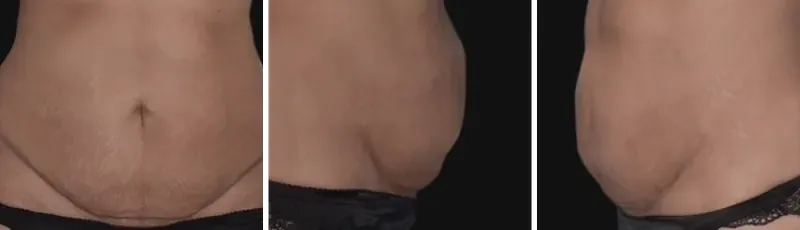
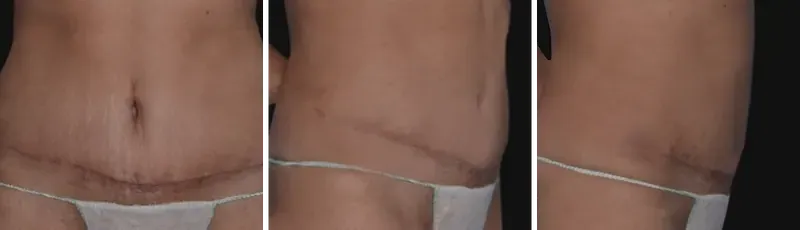
Clinical photographs
These images show surgical results and include nudity. They are for adults considering surgery.
Risks and possible complications
A tummy tuck is major surgery, and complications are more common than after many other cosmetic operations. In a US database study of 25,478 abdominoplasties, 4.0% had a major complication needing further treatment within 30 days, most often a haematoma, infection or blood clot. Most complications are treatable, but it is important to know about them before you decide.
- Seroma: a fluid collection under the skin, the most common local complication, usually drained with a needle in clinic
- Bleeding or haematoma, occasionally needing a return to theatre
- Wound infection, treated with antibiotics and sometimes dressings
- Delayed wound healing or wound breakdown, most often at the centre of the scar
- Skin or fat necrosis, where part of the skin loses its blood supply, much more likely in smokers
- Blood clots in the legs (DVT) or lungs (pulmonary embolism)
- Numbness of the lower abdomen, which improves over 12–18 months but may be partly permanent
- Wide, raised, stretched or keloid scars, and scars that sit higher than expected
- Belly button problems: poor shape, narrowing, or rarely loss of the belly button
- Asymmetry or “dog ears” (small bulges at the ends of the scar) that may need a minor revision
- Recurrence of muscle separation, particularly after a later pregnancy
- Risks of general anaesthetic, including chest infection and reactions to medicines
- Unsatisfactory cosmetic result, sometimes needing further surgery
How risk is reduced
The biggest factors you can influence are smoking and weight. Nicotine narrows small blood vessels, and smokers have substantially higher rates of wound breakdown and skin necrosis, which is why we ask you to stop all nicotine products, including vapes and patches, for at least 6 weeks before and after surgery. A stable weight in a healthy range lowers the risk of wound and clotting problems.
On the clinical side, your surgeon and anaesthetist will assess your clotting risk, use compression stockings and calf pumps, get you walking early and prescribe blood-thinning injections where appropriate. Careful handling of the tissues, a layered closure and either drains or quilting stitches aim to reduce fluid collections.
Combining a tummy tuck with other operations increases the risk. In the same large study, the complication rate was 3.1% for a tummy tuck alone, rising to 3.8% when it was combined with liposuction and 10.4% when it was combined with liposuction and other body-contouring surgery. Your surgeon will discuss whether doing procedures together or in stages is more sensible for you.
Any revision surgery, and the cost of treating complications, should be discussed openly before you commit. Under iQonic’s terms, a request for revision must be made in writing within 12 months of your operation, and any agreed revision must take place within 18 months.
Alternatives to consider
The main alternatives are a smaller operation, liposuction alone, targeted exercise and physiotherapy, or no treatment. Which is sensible depends on whether your concern is mainly skin, fat or muscle.
Option | Treats | Scar | Typical desk-work return |
|---|---|---|---|
Full tummy tuck | Loose skin above and below the belly button, muscle gap, some fat | Hip to hip, plus around belly button | 3–4 weeks |
Mini tummy tuck | Loose skin below the belly button only | Shorter, low scar | 1–2 weeks |
Liposuction | Fat only, where the skin is still firm | Several small incisions | A few days to 1 week |
Physiotherapy | Muscle function and mild separation | None | None |
Physiotherapy should come first for muscle separation after pregnancy. A women’s health (pelvic health) physiotherapist can improve core function, and some gaps close well without surgery.
Liposuction alone suits people with good skin tone and pockets of fat, but it does not tighten skin and can make loose skin look worse. Non-surgical skin tightening devices can make small changes to mild laxity but cannot remove an overhang or repair muscle.
If you have lost a large amount of weight and have loose skin in several directions or all the way round, a fleur-de-lis abdominoplasty or lower body lift may suit you better; see our guide to body contouring after weight loss.
How much does a tummy tuck cost?
At iQonic, a tummy tuck costs from £10,495. Your personal quote is given after your consultation, once your surgeon has examined you and agreed a plan.
What can change the price:
- how much skin and fat needs to be removed, and whether an extended incision is needed;
- whether you also need liposuction of the waist or flanks, in which case your surgeon may recommend a lipo-abdominoplasty instead, which is priced by the number of liposuction areas;
- umbilical or other hernia repair;
- the number of nights in hospital and the hospital used;
- your surgeon.
For context, the NHS website gives a typical UK range of about £5,000 to £10,000, a figure last reviewed in 2023. When comparing quotes, check what each one includes: surgeon and anaesthetist fees, hospital stay, garments, follow-up appointments, and how complications or revisions are handled. A lower headline figure can exclude some of these.
Quotes are valid for three months. Your deposit becomes non-refundable only after the 14-day reflection period. Cosmetic tummy tucks are rarely available on the NHS. Information about paying in instalments is on our pricing and finance page.
Your surgeon
Your consultation is with the consultant who would operate. Check any surgeon on the GMC register.
What happens next
Consultation
Start with a free virtual consultation with a patient advisor if you like, then meet your surgeon at 15 Harley Street (£100) for a 45-minute consultation: an examination, options, risks, and a written plan and quote valid for three months. You are welcome to bring a partner, friend or family member.
At least 14 days to reflect
Take time to read, ask questions and decide. We never shorten it.
Consent, when you are ready
If you go ahead, you confirm the plan and give consent with your operating surgeon. Further consultations are always available before you decide.
Surgery and aftercare
At a CQC-registered hospital, with planned follow-up reviews, then free yearly check-ups and a 10-year health check. Our nurse is available evenings and weekends by call or text. Your journey in full
Questions people ask
How long does a tummy tuck take to recover from?
Most people walk the same or next day, return to desk work in 3–4 weeks and drive at around 3–4 weeks. The NHS advises allowing about 4–6 weeks off work. Heavier lifting and core exercise usually wait until 8–12 weeks because of the muscle repair. Swelling settles over 3–6 months and the scar matures over 12–18 months.
Can a tummy tuck fix diastasis recti?
Yes. Stitching the separated rectus muscles back together is a standard part of a full tummy tuck. Physiotherapy should usually be tried first, and surgery is usually advised once you have finished having children.
What is the difference between a full and a mini tummy tuck?
A full tummy tuck treats skin above and below the belly button, repairs the muscles along their whole length and repositions the belly button. A mini tummy tuck treats only the area below the belly button with a shorter scar. Choosing a mini when you need a full is a common cause of disappointment.
How big is the tummy tuck scar?
The scar usually runs low from hip to hip, placed to sit within most underwear, and there is a small scar around the belly button. It is red for the first few months and usually fades to a pale line over 12–18 months, though scar quality varies between people.
Will a tummy tuck remove stretch marks?
Stretch marks on the skin below the belly button are usually removed with that skin. Those higher up are not removed, but some move lower and may look less obvious.
Can I have a baby after a tummy tuck?
Yes, a tummy tuck does not affect fertility and pregnancy is possible afterwards. However, pregnancy can stretch the skin and the muscle repair again, so most surgeons suggest waiting until your family is complete.
Do I need drains after a tummy tuck?
Not always. Some surgeons use drains for a few days, and others use quilting stitches that often avoid them. Your surgeon will explain their approach at consultation.
What is a seroma after a tummy tuck?
A seroma is a collection of clear fluid under the skin, felt as a soft swelling that may slosh. It is the most common local complication after abdominoplasty and is usually treated by draining it with a needle in clinic, sometimes more than once.
What BMI do I need for a tummy tuck?
There is no single cut-off, but complications increase with BMI, and many UK surgeons prefer a BMI under about 30 for cosmetic abdominoplasty. Being at a stable weight matters as much as the number.
Is a tummy tuck painful?
Most people describe tightness and soreness rather than sharp pain, worst in the first few days and when getting up from lying down. It is managed with regular pain relief, and many people also have a local anaesthetic block during surgery.
Can I get a tummy tuck on the NHS?
Rarely. Cosmetic tummy tucks are not usually funded. Some local NHS policies fund removal of an overhanging apron of skin (panniculectomy) when it causes significant medical problems, usually after major weight loss.
How much does a tummy tuck cost in London?
At iQonic a tummy tuck costs from £10,495, with a written quote after consultation that is valid for three months. The price depends on the extent of surgery, any added liposuction or hernia repair, hospital stay and surgeon.
Further reading
References and further reading
- NHS — Tummy tuck (abdominoplasty)
- BAPRAS — Abdominoplasty
- BAAPS — Tummy tuck (abdominoplasty)
- NHS — Your post-pregnancy body (separated stomach muscles)
- PHIN — All about tummy tucks
- Plastic and Reconstructive Surgery — Winocour J et al. Abdominoplasty: risk factors, complication rates, and safety of combined procedures (2015;136(5):597e–606e, doi:10.1097/PRS.0000000000001700)