



What is a mini tummy tuck?
A mini tummy tuck, or partial abdominoplasty, removes a small area of loose skin and fat from the lower abdomen, below the belly button, through an incision just above the pubic area. The belly button is not moved and there is no scar around it.
It is designed for a specific problem: a lower tummy “pouch” or small overhang, often after pregnancy or a caesarean section, in someone whose skin and muscles above the belly button are still in good shape. Because less tissue is lifted and the upper abdomen is left alone, the operation is shorter and recovery is usually easier than after a full tummy tuck.
The trade-off is that it does less. A mini tummy tuck cannot tighten skin above the belly button or repair a muscle gap along the full length of the abdomen. The most common reason for disappointment is choosing a mini tummy tuck when a full one was needed, so an honest assessment at consultation matters more than the size of the scar.
Like any cosmetic operation, it is for adults (18+), it is not a weight-loss treatment, and whether it suits you is decided at consultation with the surgeon who would operate.
Who is it suitable for?
A mini tummy tuck suits adults at a stable, healthy weight whose loose skin or fat is limited to the area below the belly button, with good skin tone and no significant muscle separation above it.
You may be a good candidate if you:
- have a small lower overhang, pouch or crease, including over a caesarean-section scar;
- have firm, smooth skin above the belly button when you stand and when you lean forward;
- do not have a noticeable muscle gap or doming above the belly button;
- have been at a steady weight for at least 6–12 months;
- do not smoke, or can stop smoking and nicotine (including vapes and patches) at least 6 weeks before and after surgery.
A simple test many surgeons use: when you lean forward, if loose skin hangs from above the belly button as well as below it, a full tummy tuck usually gives a better result. The same applies if the belly button points downwards or has become stretched, or if you have a muscle gap above it.
After pregnancy
If your concern started with pregnancy, give your body time. The NHS notes that separated stomach muscles usually return to normal by the time your baby is 8 weeks old, and advises seeing your GP if the gap is still obvious then; targeted exercises, often with a physiotherapist, come first. Most surgeons advise waiting at least 6–12 months after birth and until you have finished breastfeeding and having children. See our guide to surgery after pregnancy.
Weight and health
Complication rates after abdominoplasty rise with BMI, and a mini tummy tuck will not deal with a lot of fat. If you are still losing weight, including with GLP-1 medicines, it is usually better to reach a stable weight first and to tell your surgeon and anaesthetist about any such medicines.
What happens during surgery
A mini tummy tuck usually takes 1–2 hours. It is most often done under general anaesthetic, although some smaller cases can be done under local anaesthetic with sedation.
Before the day
At your first consultation your operating surgeon examines you standing, sitting and leaning forward, checks for a muscle gap or hernia, and discusses your goals and health. You can complete the Silhouette™ questionnaire beforehand, and your records are held in the Adoreal patient portal. There is then at least 14 days’ reflection before you confirm consent; further consultations are always available with your surgeon. You will be asked to stop smoking and nicotine (including vapes and patches) at least 6 weeks before and after surgery.
On the day
- Markings. The scar is marked with you standing, low enough to sit within your underwear. If you have a caesarean-section scar, it can often be included and removed.
- Incision. A horizontal incision is made above the pubic area. It is usually shorter than a full tummy tuck scar, though its length depends on how much skin needs to be removed.
- Lifting and tightening. The lower skin and fat are lifted up to the belly button. If the lower muscles are loose, they can be tightened with stitches.
- Removal and closure. The excess skin is removed and the wound closed in layers, usually with dissolvable stitches. A drain is sometimes used for a day or two.
- Dressings and garment. Dressings and a compression garment are applied before you wake.
Blood-clot prevention is part of every operation: compression stockings and calf pumps during surgery, early walking afterwards, and blood-thinning injections if your risk assessment suggests them.
Recovery, week by week
Recovery is usually shorter and more comfortable than after a full tummy tuck, because less tissue is lifted and the upper muscles are not repaired. Most people return to desk work in 1–2 weeks and to full exercise at 6–8 weeks.
- Days 1–3
Tightness and soreness low on the abdomen, managed with regular pain relief. Walk gently from the first day. Many people go home the same day.
- Week 1
Rest at home with short, regular walks. Wear your garment day and night. You may walk slightly bent at first. A wound check is arranged.
- Week 2
Many people return to desk-based work. Avoid lifting anything heavy, including small children, and avoid bending and twisting.
- Weeks 2–4
Driving is usually possible once you can wear a seatbelt and brake hard without discomfort, often at 2–3 weeks. Swelling and firmness around the scar are normal.
- Weeks 4–8
Gentle exercise from about 4 weeks, building to full exercise, including core work, at around 6–8 weeks if you are healing well. Garment wear usually stops at around 6 weeks.
- 3–12 months
Swelling settles by about 3–6 months. The scar fades from red to pale over 12 months or longer.
When to call us
Contact the clinic if you notice sudden or one-sided swelling, spreading redness, discharge from the wound, a temperature of 38°C or above, or any darkening of the skin near the scar. Call 999 for chest pain or sudden breathlessness, and seek urgent help for a painful, swollen calf.
Avoid long-haul flights for around 6 weeks because of the blood-clot risk, and plan your recovery near home; our guide to cosmetic surgery abroad explains why aftercare close to home matters.
Results and how long they last
A mini tummy tuck gives a smoother, flatter lower abdomen, visible straight away and clearer as swelling settles over 3–6 months. The skin removed does not come back, so the result is long-lasting as long as your weight stays stable.
What it can do:
- remove a lower pouch or overhang, including over a caesarean-section scar;
- remove stretch marks in the skin that is taken away;
- tighten loose lower abdominal muscles.
What it cannot do:
- tighten skin or remove stretch marks above the belly button;
- repair a muscle gap above the belly button;
- remove fat around the internal organs, which causes a firm, rounded tummy.
Weight gain and future pregnancy can change the result. You can see examples on our before and after page; results vary between people.
Before and after
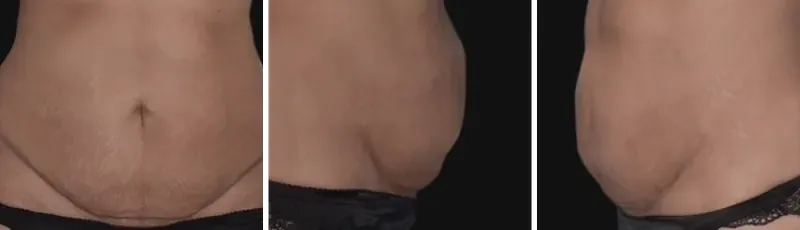
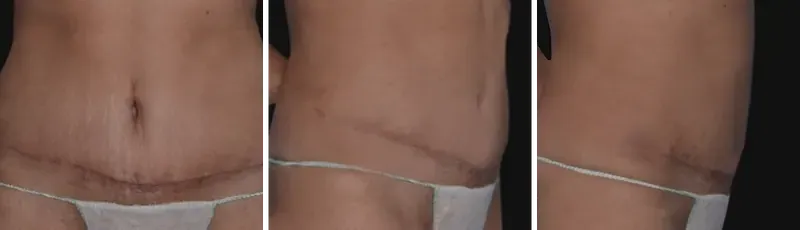
Clinical photographs
These images show surgical results and include nudity. They are for adults considering surgery.
Risks and possible complications
A mini tummy tuck is a smaller operation than a full abdominoplasty, but it is still surgery under anaesthetic with a wound across the lower abdomen. The risks are similar in kind, generally lower in frequency.
- Seroma: fluid under the skin, usually drained with a needle in clinic
- Bleeding or haematoma, occasionally needing a return to theatre
- Wound infection
- Delayed wound healing or small areas of wound breakdown, more likely in smokers
- Blood clots in the legs (DVT) or lungs (pulmonary embolism)
- Numbness of the skin between the scar and belly button, which usually improves but may be partly permanent
- Raised, stretched or keloid scars
- “Dog ears” (small bulges) at the ends of the scar
- Asymmetry or residual fullness
- Persisting loose skin or bulging above the belly button, which a mini tummy tuck does not treat
- A belly button that sits low or looks altered, if an umbilical float is used
- Risks of anaesthetic
- The possibility that a full tummy tuck is needed later to reach the result you want
How risk is reduced
Stopping smoking and nicotine (including vapes and patches) at least 6 weeks before and after surgery, being at a stable weight and following your garment and activity advice make the biggest difference. Your surgical team will assess your blood-clot risk and take steps to reduce it.
Choosing the right operation is also a form of risk reduction. A mini tummy tuck in someone who needs a full one often leads to a second operation. Your surgeon should explain clearly why they are recommending one or the other, and it is reasonable to ask to see the likely scar position.
Alternatives to consider
Alternatives include liposuction alone, a full tummy tuck, physiotherapy, or waiting. The right choice depends on whether your concern is skin, fat or muscle, and where it is.
Option | Suits | Scar | Desk-work return |
|---|---|---|---|
Mini tummy tuck | Loose skin below the belly button only | Short low scar | 1–2 weeks |
Full tummy tuck | Loose skin above and below, muscle gap | Hip to hip plus belly button | 3–4 weeks |
Liposuction | Fat with firm skin | Small incisions | A few days to 1 week |
Physiotherapy | Core weakness, mild muscle separation | None | None |
If the main issue is fat with good skin tone, liposuction may be enough, but it will not tighten loose skin. If you have a muscle gap or loose skin above the belly button, a full tummy tuck is usually the more reliable choice even though the scar is longer. For fat around the waist as well as loose skin, lipo-abdominoplasty may suit you.
How much does a mini tummy tuck cost?
At iQonic, a mini tummy tuck costs from £7,750. Your personal quote is given after consultation, once your surgeon has examined you and agreed the plan.
What can change the price:
- the amount of skin and fat removed and the length of the incision;
- lower muscle tightening or an umbilical float;
- adding liposuction to other areas;
- the anaesthetic, whether you stay overnight, and the hospital used;
- your surgeon.
When comparing quotes, check whether they include surgeon and anaesthetist fees, hospital stay, garments, follow-up and the handling of complications. Quotes are valid for three months, and your deposit becomes non-refundable only after the 14-day reflection period. Information about spreading the cost is on our pricing and finance page.
Your surgeon
Your consultation is with the consultant who would operate. Check any surgeon on the GMC register.
What happens next
Consultation
Start with a free virtual consultation with a patient advisor if you like, then meet your surgeon at 15 Harley Street (£100) for a 45-minute consultation: an examination, options, risks, and a written plan and quote valid for three months. You are welcome to bring a partner, friend or family member.
At least 14 days to reflect
Take time to read, ask questions and decide. We never shorten it.
Consent, when you are ready
If you go ahead, you confirm the plan and give consent with your operating surgeon. Further consultations are always available before you decide.
Surgery and aftercare
At a CQC-registered hospital, with planned follow-up reviews, then free yearly check-ups and a 10-year health check. Our nurse is available evenings and weekends by call or text. Your journey in full
Questions people ask
Who is a mini tummy tuck suitable for?
Adults at a stable weight whose loose skin or fat is limited to below the belly button, with firm skin and no significant muscle gap above it. If skin hangs from above the belly button when you lean forward, a full tummy tuck is usually more suitable.
What is the difference between a mini and a full tummy tuck?
A mini tummy tuck treats only below the belly button, with a shorter scar and no scar around the belly button. A full tummy tuck treats the whole abdomen, repairs the muscles along their length and repositions the belly button, with a longer recovery.
How long is the mini tummy tuck scar?
It is usually shorter than a full tummy tuck scar and sits low, above the pubic area, within most underwear. Its exact length depends on how much skin is removed; your surgeon will mark it with you before surgery.
Can a mini tummy tuck fix a C-section overhang?
Often, yes. A lower overhang over a caesarean-section scar is one of the most common reasons for a mini tummy tuck, and the old scar can usually be removed in the process. If there is also a muscle gap or loose skin higher up, a full tummy tuck may be needed.
Does a mini tummy tuck tighten the muscles?
It can tighten the lower muscles below the belly button. It cannot repair a gap above the belly button; that needs a full tummy tuck.
How long does it take to recover from a mini tummy tuck?
Most people return to desk work in 1–2 weeks, drive at about 2–3 weeks and return to full exercise at 6–8 weeks. Swelling settles over 3–6 months.
Is a mini tummy tuck done under local anaesthetic?
It is usually done under general anaesthetic. Some smaller cases can be done under local anaesthetic with sedation; your surgeon and anaesthetist will advise what is appropriate for you.
Can I combine a mini tummy tuck with liposuction?
Yes. Liposuction of the upper abdomen or flanks is sometimes added to improve contour where the skin is still firm. It adds to the cost and recovery.
Will my belly button change?
In a standard mini tummy tuck the belly button is not moved. In a variation called an umbilical float it is lowered slightly, which your surgeon should discuss with you beforehand.
How much does a mini tummy tuck cost in London?
At iQonic a mini tummy tuck costs from £7,750, confirmed in a written quote after consultation that is valid for three months.
Further reading
References and further reading
- NHS — Tummy tuck (abdominoplasty)
- BAPRAS — Abdominoplasty
- BAAPS — Tummy tuck (abdominoplasty)
- NHS — Your post-pregnancy body (separated stomach muscles)
- PHIN — All about tummy tucks
- Plastic and Reconstructive Surgery — Winocour J et al. Abdominoplasty: risk factors, complication rates, and safety of combined procedures (2015;136(5):597e–606e, doi:10.1097/PRS.0000000000001700)