



What are breast reduction and breast lift surgery?
A breast reduction (reduction mammoplasty) removes excess breast tissue, fat and skin so the breasts are smaller, lighter and in better proportion to the body. A breast lift (mastopexy) removes excess skin and reshapes the existing tissue so the breast sits higher and firmer, without necessarily changing its size. In both, the nipple and areola are moved higher and can be made smaller.
The two operations use the same principles and often overlap: most reductions include a lift, and a lift can be combined with a small reduction or with an implant to restore upper-breast volume. Your surgeon will recommend the combination that fits your goals.
For many women with large breasts the main reasons are physical: back, neck and shoulder discomfort, grooves from bra straps, rashes under the breast fold, and difficulty exercising or finding clothes that fit. For others, a lift restores shape after pregnancy, breastfeeding or weight loss. Consultations take place at 15 Harley Street, London. Men with enlarged breast tissue should see our gynaecomastia page.
Who is it suitable for?
Breast reduction and lift surgery suits adults whose breasts have finished developing, who are close to a stable, healthy weight and who accept permanent scars in exchange for a change in size or shape. You may be a suitable candidate if you:
- have back, neck or shoulder pain, bra-strap grooving or skin irritation under the breasts;
- find that breast size limits exercise or everyday activities;
- have breasts that have dropped or emptied after pregnancy, breastfeeding or weight loss (see our guides to surgery after pregnancy and body contouring after weight loss);
- have one breast noticeably larger or lower than the other (see breast asymmetry correction);
- are a non-smoker, or can stop well before and after surgery.
It is usually worth waiting if you plan more pregnancies soon or are still losing weight, because both can change the result. A reduction is likely to affect your ability to breastfeed, so tell your surgeon if you hope to have children. Smoking and a raised BMI significantly increase the risk of wound healing problems.
Suitability is decided in person by the surgeon who will operate. There is a reflection period of at least 14 days between your first consultation and consent, with further consultations available whenever you want them.
Techniques and incision patterns
The technique depends mainly on how much tissue needs removing and how far the nipple needs to move. Your surgeon will recommend the least extensive option that achieves your goals.
Around the areola (periareolar)
A single scar around the edge of the areola. Suits a small lift or reduction, where the nipple needs to move only a short distance. It can flatten the breast slightly.
Vertical (“lollipop”)
A scar around the areola and a vertical line down to the breast fold. Suits moderate reductions and lifts, and gives good forward projection.
Anchor (inverted T, Wise pattern)
Adds a horizontal scar in the breast fold. Used for larger reductions and more significant sagging, where more skin needs removing.
Free nipple graft
For very large reductions, the nipple and areola are removed and replaced as a skin graft. Nipple sensation and the ability to breastfeed are lost, and the nipple may lose some colour.
Lift with implants (augmentation-mastopexy)
Combines a lift with an implant to restore upper-breast fullness. It may be done in one or two stages, depending on your tissue.
Breast augmentationLiposuction reduction
Removes fatty breast tissue through small incisions, with minimal scarring. It gives a modest reduction only and does not lift the breast.
LiposuctionWhat happens during surgery
Breast reduction usually takes 2–3 hours under general anaesthetic. At iQonic it is a day case: you go home the same day.
Before surgery. You complete the Silhouette™ questionnaire through Adoreal, then meet your surgeon to discuss symptoms, goals and future plans for pregnancy. Your surgeon examines and measures you and may use 3D imaging to show the planned shape. After at least 14 days’ reflection you confirm your decision and give written consent; further consultations are always available. A pre-operative assessment checks your fitness for anaesthetic, and you may need a mammogram depending on your age and history.
On the day:
- Your surgeon draws the new breast shape and nipple position on your skin with you standing.
- Under general anaesthetic, the nipple and areola are kept attached to a bridge of tissue (a pedicle) that carries their blood supply and some of their nerves.
- Excess tissue, fat and skin are removed, and the remaining tissue is shaped into a higher, more rounded breast.
- The nipple is moved to its new position and the areola reduced if needed.
- The incisions are closed in layers with fine, usually dissolvable, stitches. Small drains may be placed for a day or two, and a support bra is fitted.
Removed tissue is routinely sent for laboratory examination. Surgery takes place at The A Lounge, 15 Harley Street in London.
Recovery, week by week
Most people return to desk work after 2–3 weeks and to strenuous exercise at about 6 weeks. Swelling takes several months to settle fully.
Call us straight away if one breast becomes suddenly swollen, tense or bruised; if you develop a fever, spreading redness or discharge; if a nipple becomes dark, blue or cold; or if pain worsens rather than improves. Calf pain or swelling needs same-day assessment; chest pain or breathlessness is an emergency, so call 999.
- Days 1–3
Soreness, tightness, bruising and swelling are normal and controlled with prescribed pain relief. Any drains are usually removed within 24–48 hours. Wear your support bra day and night and walk regularly to help circulation.
- Week 1
Tiredness is common and can last for weeks. Avoid lifting, stretching and raising your arms above your head. Your first wound check and dressing change is usually within the first week or so.
- Weeks 2–3
Most people return to desk work. Drive only when wearing a seatbelt is no longer painful and you can make an emergency stop. BAPRAS advises no driving for at least the first week; the NHS notes it may take several weeks. Small areas of delayed healing, often where incisions meet, are common and usually heal with dressings.
- Weeks 4–6
Gradual return to exercise as advised, with a well-fitted sports bra. Avoid heavy lifting and high-impact exercise until about 6 weeks.
- 3 months
Most swelling has gone and the breasts have largely settled into their new shape. Scars are often still red and may feel lumpy.
- 6–12 months
The final shape is established. Scars continue to flatten and fade, which can take up to 2 years.
Results and how long they last
The change in size and position is immediate, but the final shape appears over 6–12 months as swelling settles and the tissues relax. Breasts often look high and square at first and then soften into a more natural shape.
Many women with large breasts report less back, neck and shoulder discomfort after reduction, and find exercise and clothes easier. Surgery cannot promise relief of symptoms, and your surgeon will assess whether your symptoms are likely to be related to breast size.
A reduction is long-lasting, but breasts continue to change with age, gravity, pregnancy and weight change. A lift in particular will relax somewhat over time, and a lift combined with an implant may drop sooner because of the implant’s weight. Breasts can also grow again during pregnancy. Scars are permanent: they fade and flatten but do not disappear, and are usually hidden by underwear or swimwear. See results shared with patient consent on our before and after page.
Breast screening. Reduction and lift surgery can leave scar tissue that shows on mammograms. Tell the radiographer about your surgery so the images are read correctly.
Before and after
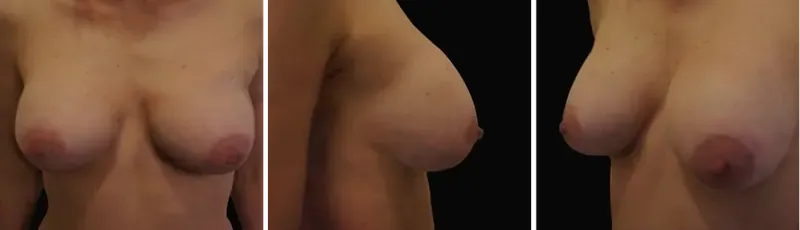
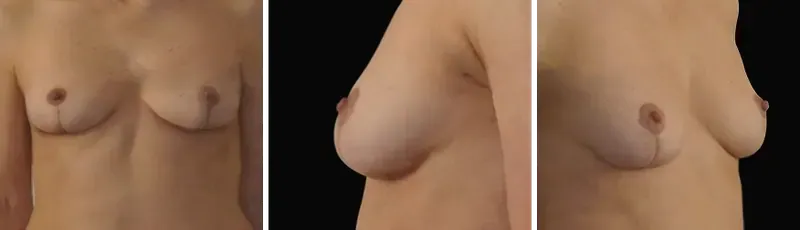
Clinical photographs
These images show surgical results and include nudity. They are for adults considering surgery.
Risks and possible complications
Breast reduction and lift are major operations with long scars. Most people recover well, but it is important to understand what can go wrong before you decide.
- Bleeding or haematoma, which may need a return to theatre
- Infection, usually treated with antibiotics
- Blood clots: deep vein thrombosis (DVT) or pulmonary embolism
- Reactions or complications related to the anaesthetic
- Delayed wound healing or wound breakdown, especially where incisions meet
- Fat necrosis: firm lumps where fatty tissue has lost its blood supply
- Reduced or lost nipple and breast sensation, which can be permanent
- Partial or complete loss of the nipple and areola (rare)
- Being unable to breastfeed in future
- Asymmetry in size, shape or nipple position
- Thickened, raised, stretched or keloid scars
- Puckering or “dog ears” at the ends of scars
- Recurrence of sagging over time, or a result different from what you hoped for
- Need for revision surgery
Breastfeeding. BAPRAS patient information advises that you may well not be able to breastfeed after breast reduction, and the NHS lists being permanently unable to breastfeed as a possible outcome. If breastfeeding matters to you, discuss timing and technique before deciding.
Smoking and weight. Smoking, including nicotine replacement and vaping, reduces blood supply to healing tissue and greatly increases the risk of wound breakdown and nipple problems. You will be asked to stop well before and after surgery. A higher BMI also increases the risk of wound complications.
How we reduce risk: careful assessment and planning, choosing a technique that protects blood supply to the nipple, measures to prevent blood clots and close follow-up of your wounds.
Alternatives to consider
Surgery is not the only way to manage large or sagging breasts, and choosing not to have an operation is always reasonable.
- Professional bra fitting and support: a well-fitted bra and a supportive sports bra can reduce discomfort.
- Physiotherapy and exercise: strengthening the back and shoulders can help posture-related pain.
- Weight loss: if you are above a healthy weight, losing weight may reduce breast size and lower the risks of surgery.
- Liposuction alone: a modest reduction with smaller scars, but no lift.
- Implants alone: for mild sagging with low volume, an implant may be enough without a lift.
- NHS treatment: breast reduction is sometimes funded by the NHS for women with health problems caused by large breasts when other treatments have not helped; criteria vary by area and are strict.
If your main concern is the size of the nipples or areolas, see nipple reduction.
How much does a breast reduction or lift cost?
Breast reduction and lift at iQonic costs from £10,950. The price for a lift alone, or a lift combined with implants, is confirmed at consultation.
Your final price depends on the technique, how much tissue is removed, the length of hospital stay, whether implants are used and your aftercare plan. After consultation you receive a written quote, valid for three months. Your deposit is non-refundable once the 14-day reflection period has passed.
The NHS website quotes a typical UK cost of around £6,500 for breast reduction, plus consultations and follow-up. When comparing quotes, check what is included: consultations with the operating surgeon, anaesthetist, overnight stay, garments, dressings and follow-up. Finance is available through our credit partner; see pricing and finance.
Your surgeon
Your consultation is with the consultant who would operate. Check any surgeon on the GMC register.
What happens next
Consultation
Start with a free virtual consultation with a patient advisor if you like, then meet your surgeon at 15 Harley Street (£100) for a 45-minute consultation: an examination, options, risks, and a written plan and quote valid for three months. You are welcome to bring a partner, friend or family member.
At least 14 days to reflect
Take time to read, ask questions and decide. We never shorten it.
Consent, when you are ready
If you go ahead, you confirm the plan and give consent with your operating surgeon. Further consultations are always available before you decide.
Surgery and aftercare
At a CQC-registered hospital, with planned follow-up reviews, then free yearly check-ups and a 10-year health check. Our nurse is available evenings and weekends by call or text. Your journey in full
Questions people ask
Will a breast reduction help my back and neck pain?
Many women with heavy breasts report less back, neck and shoulder discomfort after reduction, but it cannot be promised. Your surgeon will assess whether your symptoms are likely to be caused by breast size, and whether other causes should be looked at first.
What is the difference between a breast reduction and a breast lift?
A reduction removes breast tissue to make the breasts smaller, and usually lifts them too. A lift removes excess skin and reshapes the breast so it sits higher, without significantly changing its size. Both move the nipple higher.
How long is recovery after a breast reduction?
Most people take 2–3 weeks off desk work and return to strenuous exercise at about 6 weeks. Swelling settles over 3 months, and the final shape appears over 6–12 months.
What do breast reduction scars look like?
Scars go around the areola and, depending on the technique, down to the breast fold (lollipop) and along the fold (anchor). They are red at first and fade and flatten over 12–24 months, but are permanent. They are usually hidden by underwear.
Can I breastfeed after a breast reduction?
Some women can, but many cannot, because milk ducts are divided during surgery. BAPRAS advises that you may well not be able to breastfeed afterwards. If you plan to breastfeed, discuss timing with your surgeon.
Can I get a breast reduction on the NHS?
Sometimes, if large breasts cause health problems such as back pain or skin irritation and other treatments have not helped. Criteria vary by area and are strict. Surgery purely for appearance is not funded.
Can I have a breast lift without implants?
Yes. A lift reshapes your own tissue and raises the nipple. If you would also like more upper-breast fullness, an implant can be added at the same time or in a second stage.
Will I lose nipple sensation?
Most people keep some sensation, but reduced or lost nipple sensation is a recognised risk and can be permanent. It is more likely with very large reductions, and certain with a free nipple graft.
What is the right age for breast reduction?
There is no single right age. Surgery is for adults whose breasts have finished developing, ideally at a stable weight and when you are not planning another pregnancy soon.
Will my breasts stay lifted?
The result is long-lasting, but breasts continue to age. Gravity, pregnancy and weight change will cause some relaxation over time, and some women later choose a further lift.
How much does a breast reduction cost in London?
At iQonic, breast reduction and lift costs from £10,950. Your exact price is confirmed in a written quote after consultation, and finance is available.