

What is Preserve by Motiva® breast augmentation?
Preserve by Motiva® breast augmentation is a way of placing a breast implant that aims to disturb as little of the breast’s natural structure as possible. Instead of cutting a pocket for the implant, the surgeon opens a natural tissue layer by gentle, controlled balloon expansion and then places the implant through a sterile sleeve so that it does not touch the skin.
At iQonic we perform it with Preserve by Motiva®, a set of instruments and implants from Establishment Labs, the maker of Motiva® implants. The implant sits behind the breast gland and in front of the chest muscle, in a layer the published literature calls the posterior intralamellar plane. Anatomical studies describe it as a consistent layer between the breast gland and the fascia covering the chest muscle, containing no glandular tissue.
The idea is that by respecting the supporting ligaments (Cooper’s ligaments), nerves and blood supply of the breast, recovery is gentler and the implant sits and moves more naturally. These aims are supported by early evidence, described below, but long-term data are still to come.
Preserve by Motiva® is one of three implant techniques at iQonic, alongside traditional augmentation and Mia Femtech®. Consultations take place at 15 Harley Street, London.
Who is it suitable for?
Preserve by Motiva® suits healthy adults over 18 who want a moderate increase in size and have enough breast tissue to cover an implant placed in front of the muscle. You may be a suitable candidate if you:
- want more volume or upper-breast fullness in proportion to your frame;
- have lost volume after pregnancy, breastfeeding or weight loss;
- would like a larger change than Mia Femtech® is designed to give;
- have little or no sagging, with nipples sitting above the breast fold;
- are at a stable weight, in good health and a non-smoker, or able to stop.
It may be less suitable if you are very slim with little breast tissue, where an implant partly behind the muscle may give better cover; if you have significant sagging, which needs a breast lift; or if you have a tuberous breast shape or marked asymmetry that needs the breast itself to be reshaped.
Your operating surgeon decides suitability in person. After your first consultation there is a reflection period of at least 14 days before you give written consent; further consultations are always available.
How Preserve by Motiva® compares with other techniques
The three iQonic techniques differ in how the implant space is made, how large a change is possible and how much long-term evidence exists.
Preserve by Motiva®
Short breast-fold incision, balloon-assisted space in front of the muscle, no-touch sleeve. Aims for a gentler recovery with a moderate range of sizes. Early published evidence. From £9,850.
Traditional breast augmentation
The implant pocket is created by dissection, in front of or partly behind the muscle, under general anaesthetic. Suits larger changes, asymmetry, or an implant combined with a lift. From £9,750.
Breast augmentationMia Femtech®
Small implants through the armpit under local anaesthetic with sedation, for a modest change of around one to two cup sizes. One 100-patient study with 3-year follow-up. From £11,950.
Mia Femtech®What the evidence shows
Tissue-preserving augmentation is new, and the published evidence is promising but early. The first clinical papers appeared in a 2026 supplement of Aesthetic Surgery Journal that was sponsored by Establishment Labs, the manufacturer.
The largest case series so far (Pittman and colleagues, 2026) reported 159 consecutive women treated at five centres:
- Implants were placed through a short breast-fold incision into the plane in front of the pectoral fascia.
- 58% had local anaesthetic with sedation, 36% a general anaesthetic and 6% local anaesthetic alone.
- At 3 months there were no haematomas; there was one infection, one malposition and one case of rippling (each about 1%).
- Half of the women reported returning to normal activities within a day.
What to bear in mind: average follow-up in that series was about 5 months, there was no comparison group, and the studies were supported by the manufacturer. An accompanying editorial notes that independent replication and longer-term data on capsular contracture and malposition are still needed. Traditional augmentation has decades of data by comparison.
Our guide to Mia Femtech® vs Preserve by Motiva® vs traditional breast augmentation sets the evidence for each technique side by side.
What happens during surgery
Preserve by Motiva® is usually a day-case operation, and you go home the same day with an adult.
Before surgery. You complete the Silhouette™ questionnaire through Adoreal so your surgeon understands your goals. At consultation your surgeon examines and measures you and uses 3D imaging to preview implant options on your own body. After at least 14 days’ reflection, you confirm your decision and give written consent; further consultations are always available.
On the day:
- Your surgeon marks the plan with you standing. You have sedation with local anaesthetic, or a general anaesthetic, as agreed in advance. The depth of anaesthesia is tracked with BIS™ monitoring.
- Fluid containing local anaesthetic is used to gently separate the tissue layers (hydrodissection).
- Through a short incision in the breast fold, a narrow tunnel is made to the plane behind the breast gland.
- A balloon device is inflated in stages to open the space for the implant, instead of cutting it.
- The Motiva® implant is placed through the Motiva® insertion sleeve, so it never touches the skin.
- The incision is closed with dissolvable stitches and a soft support bra is fitted.
Operations take place at our partner hospital, Fitzrovia Hospital in London. Follow-up reviews may include an ultrasound check.
Recovery, week by week
Recovery is often gentler than after traditional augmentation, but you still need to protect the implant space while it heals. Most people are back at a desk after about a week and avoid upper-body exercise for 4–6 weeks.
Call us straight away if one breast becomes suddenly swollen, tense or bruised, if you develop a fever, spreading redness or wound discharge, or if pain gets worse rather than better. Calf pain or swelling needs same-day assessment; chest pain or breathlessness is an emergency, so call 999.
- Day of surgery
A short stay in recovery, then home with an adult. Tightness, swelling and soreness are normal. Take pain relief as prescribed and wear your support bra day and night.
- Days 1–7
Many people feel able to do light activities within a few days. Keep your arms below shoulder height and avoid lifting. Your first check is usually around a week after surgery.
- Weeks 1–2
Most return to desk work after about a week. Drive once you can wear a seatbelt comfortably and make an emergency stop.
- Weeks 2–4
Walking and gentle lower-body exercise can usually restart. The breasts may still sit slightly high and feel firm.
- Weeks 4–6
Gradual return to upper-body exercise and heavier lifting when your surgeon advises.
- 3 months
Swelling has settled and the breasts feel softer and more natural. The breast-fold scar continues to fade over 12–18 months.
Results and how long they last
The increase in size is visible immediately, and the shape softens and settles over about 3 months. In one early study of the technique, most women showed improved upper-breast fullness with nipple position maintained, but individual results vary.
Implants are long-lasting but are not lifetime devices. The NHS advises they may need replacing at around 10 years, and many women keep them longer without problems. Preserving tissue does not stop the breast from ageing: pregnancy, weight change and gravity will still affect the breast around the implant.
Your implant details are recorded on the national Breast and Cosmetic Implant Registry. You can still take part in NHS breast screening, but tell the radiographer about your implants; implants in front of the muscle can make mammograms a little harder to read, so extra views are taken. Most women with implants can breastfeed, although milk supply may be slightly reduced. See results shared with patient consent on our before and after page.
Before and after
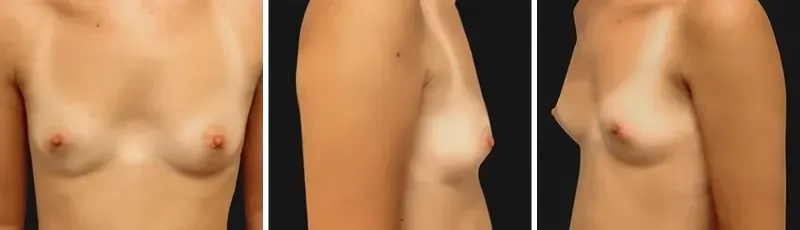
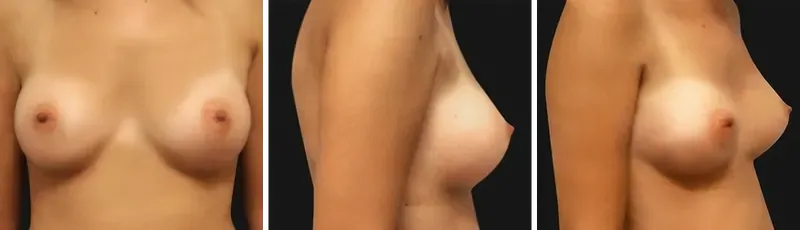
Clinical photographs
These images show surgical results and include nudity. They are for adults considering surgery.
Risks and possible complications
Preserve by Motiva® is designed to reduce tissue disruption, but it is still breast implant surgery and carries the same categories of risk. Your surgeon will explain how each applies to you.
- Bleeding or haematoma, which may need a return to theatre
- Infection, which occasionally means the implant has to be removed
- Blood clots: deep vein thrombosis (DVT) or pulmonary embolism
- Reactions to sedation or general anaesthetic
- Capsular contracture: tightening of the scar capsule around the implant
- Implant malposition or asymmetry
- Rippling or visible implant edges, especially if tissue cover is thin
- Implant rupture or gel leak over time
- Changes in nipple or breast sensation
- Thickened or stretched scars in the breast fold
- Seroma (fluid around the implant), including late seroma, which needs assessment
- BIA-ALCL and other rare implant-associated cancers
- A size or shape different from what you hoped for, or need for further surgery
BIA-ALCL. Breast implant-associated anaplastic large cell lymphoma is a rare cancer of the immune system that develops around an implant. The MHRA reports a UK rate of around 1 in 12,187 breast implants and tissue expanders sold, with almost all cases linked to textured implants, and symptoms appearing on average 7–10 years after surgery. Any new swelling of a breast with an implant should be checked promptly.
Breast implant illness. Some people with implants report symptoms such as fatigue, joint pain and “brain fog”. The MHRA says it is not currently known whether there is a link with implants and continues to monitor reports.
About long-term risk. Because published follow-up for Preserve by Motiva® is measured in months, rates of problems that develop over years, such as capsular contracture, are not yet known for this technique. Motiva® implants are covered by the Always Confident Warranty® against rupture for the life of the implant, with product replacement for Baker grade III–IV capsular contracture for 10 years; Motiva JOY® adds a 5-year extended warranty. The MHRA’s breast augmentation risk awareness tool is a useful checklist before your consultation.
Alternatives to consider
Preserve by Motiva® is one of several options, and choosing not to have surgery is always reasonable.
- Traditional augmentation: the most flexible option, including placement partly behind the muscle for slim patients.
- Mia Femtech®: an armpit approach under local anaesthetic with sedation, for a smaller change.
- Fat transfer: your own fat instead of an implant, usually for a modest increase, sometimes over more than one session.
- Breast lift: if sagging is the main concern, with or without an implant.
How much does Preserve by Motiva® breast augmentation cost?
Preserve by Motiva® breast augmentation at iQonic costs from £9,850. Your final price depends on your anatomy, the Motiva® implant chosen, the type of anaesthetic, the hospital and your aftercare plan.
After consultation you receive a written quote, valid for three months. Your deposit is non-refundable once the 14-day reflection period has passed. When comparing quotes, check whether they include consultations with the operating surgeon, implants and warranty, anaesthetic, hospital fees, garments and follow-up.
For comparison, traditional augmentation at iQonic starts from £9,750 and Mia Femtech® from £11,950. Our breast augmentation cost guide explains UK prices in more detail, and finance is available through our credit partner: see pricing and finance.
Your surgeon
Your consultation is with the consultant who would operate. Check any surgeon on the GMC register.
What happens next
Consultation
Start with a free virtual consultation with a patient advisor if you like, then meet your surgeon at 15 Harley Street (£100) for a 45-minute consultation: an examination, options, risks, and a written plan and quote valid for three months. You are welcome to bring a partner, friend or family member.
At least 14 days to reflect
Take time to read, ask questions and decide. We never shorten it.
Consent, when you are ready
If you go ahead, you confirm the plan and give consent with your operating surgeon. Further consultations are always available before you decide.
Surgery and aftercare
At a CQC-registered hospital, with planned follow-up reviews, then free yearly check-ups and a 10-year health check. Our nurse is available evenings and weekends by call or text. Your journey in full
Questions people ask
What is the difference between traditional and Preserve by Motiva® breast augmentation?
In traditional augmentation the implant pocket is cut, in front of or partly behind the muscle. Preserve by Motiva® opens a natural layer behind the breast gland by gentle balloon expansion and places the implant through a no-touch sleeve, aiming to protect ligaments, nerves and blood supply. Traditional augmentation has much longer follow-up data.
What is Preserve by Motiva®?
Preserve is a system of instruments and techniques from Establishment Labs, the maker of Motiva® implants, for tissue-preserving breast augmentation. It includes balloon-assisted creation of the implant space and a sleeve for no-touch implant placement.
Is Preserve by Motiva® breast augmentation done under local anaesthetic?
It can be. In the largest published series, 58% of women had local anaesthetic with sedation and 36% had a general anaesthetic. Your surgeon and anaesthetist will recommend what suits you.
How long is recovery after Preserve by Motiva® breast augmentation?
Many people return to light activities within a few days and to desk work after about a week. Avoid heavy lifting and upper-body exercise for 4–6 weeks. The result settles over about 3 months.
Is Preserve by Motiva® over or under the muscle?
Over the muscle. The implant sits behind the breast gland and in front of the pectoral fascia, in a layer sometimes called the posterior intralamellar plane. This avoids the muscle movement problems that can occur with implants behind the muscle.
Where is the scar with Preserve by Motiva®?
Usually a short incision in the fold beneath the breast, around 2.5 cm. It is pink at first and fades over 12–18 months.
Will I keep nipple sensation?
The technique is designed to respect the nerves supplying the nipple, which is intended to help preserve sensation. Early studies report few sensory problems, but changes in sensation remain a risk of any breast surgery.
How long do Preserve by Motiva® results last?
The implants are long-lasting but not lifetime devices; the NHS advises they may need replacing at around 10 years. The breast will still change with age, pregnancy and weight.
Is there good evidence for Preserve by Motiva® breast augmentation?
The early evidence is encouraging, with low complication rates in the first months. However, follow-up is short, there are no comparison groups yet and the studies were sponsored by the manufacturer. Longer-term data are still needed.
How much does Preserve by Motiva® breast augmentation cost in London?
At iQonic it costs from £9,850. Your exact price is confirmed in a written quote after consultation.
Can I see my likely result before surgery?
Yes. 3D imaging, available through our Adoreal platform, lets you preview how different implants could look on your body. It is a planning aid rather than a promise of the final result.
Further reading
References and further reading
- Aesthetic Surgery Journal — Minimally invasive, tissue-preserving breast augmentation: insights from a large case series (Pittman et al., 2026)
- Aesthetic Surgery Journal — Tissue preservation in primary breast augmentation: from founding concepts to early evidence (Graf and LeBlanc, 2026)
- NHS — Breast enlargement (implants)
- MHRA — Breast implant associated anaplastic large cell lymphoma (BIA-ALCL)
- MHRA — Symptoms sometimes referred to as breast implant illness
- NHS England — Breast and Cosmetic Implant Registry
- MHRA — Cosmetic breast augmentation risk awareness tool