
The short answer
The right technique depends mainly on how much change you want, the shape and tissue of your breasts now, and how much weight you place on a short recovery versus a longer track record. As a rule of thumb:
- Mia Femtech® suits women who want an increase of one to two cup sizes, with minimal asymmetry, and a short recovery.
- Preserve by Motiva® (Preserve by Motiva®) suits women who want a little more choice of size than Mia Femtech® allows, with the same gentle, balloon-assisted technique and the same recovery; the incision sits in the fold under the breast rather than the armpit.
- Traditional breast augmentation suits those who want a larger change, have some asymmetry or need more control over shape, or who need an implant combined with a lift.
None of the three corrects drooping (ptosis) on its own. If your nipples sit at or below the fold under your breast, you may need a lift, with or without an implant, and neither Mia Femtech® nor Preserve by Motiva® is usually the right choice. Your surgeon will tell you this at consultation.
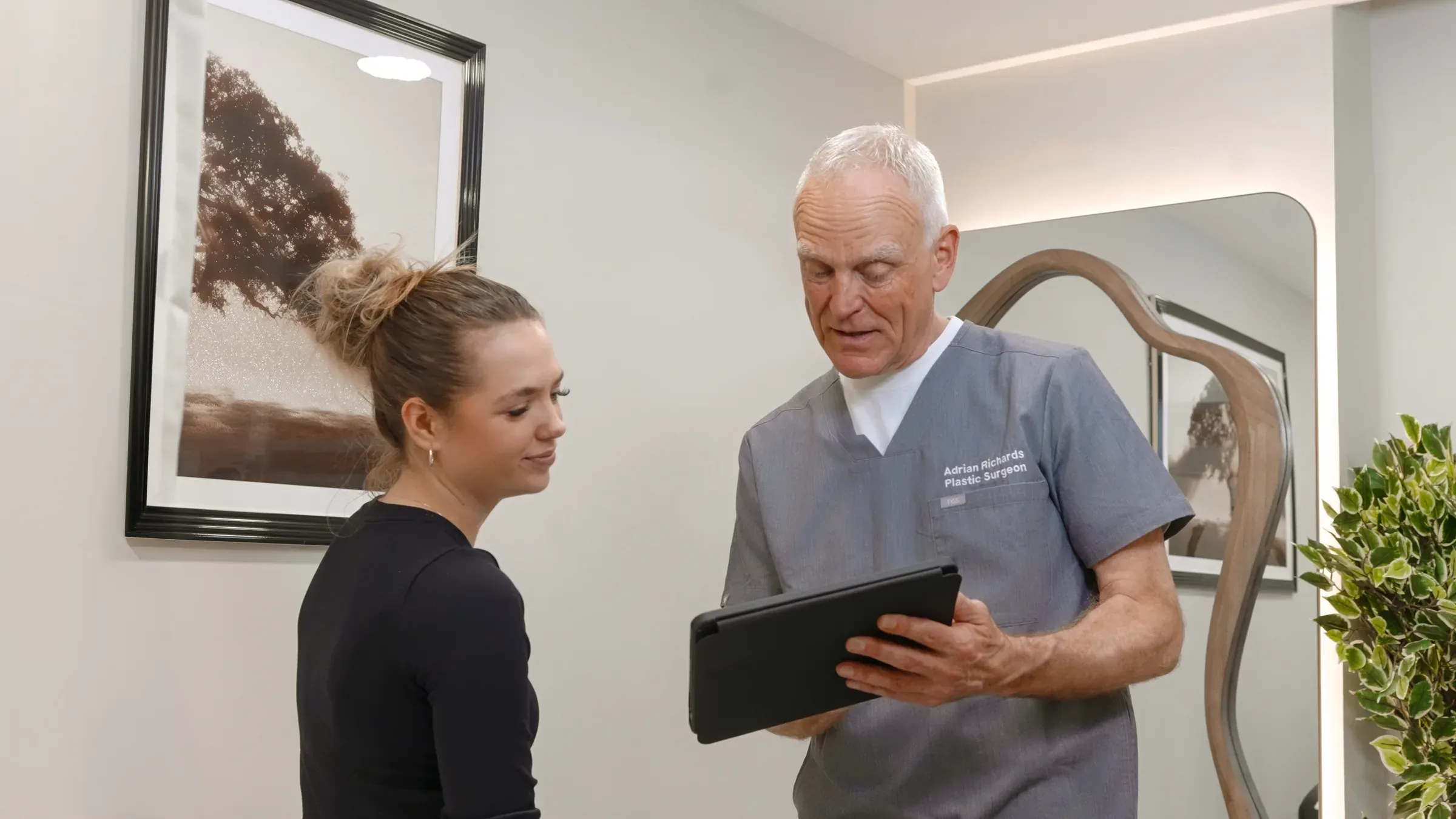
At iQonic, all three are offered by consultant plastic surgeons. Mr Adrian Richards was the first surgeon in the UK to provide Mia Femtech®, and Dr Ali Arnaout is Mia Femtech® certified and performs Preserve by Motiva®. The choice of technique is made together with your operating surgeon after an examination, never from a price list.
What each technique involves
All three techniques place a silicone gel implant to add volume. They differ in where the incision is, how the space for the implant (the pocket) is made, how large the implant can be, and the type of anaesthetic.
Traditional breast augmentation
This is the operation most people picture. Under general anaesthetic, the surgeon usually makes an incision in the fold under the breast and creates a pocket either behind the breast tissue, behind the thin layer of fascia covering the chest muscle, or partly behind the muscle (dual plane). The choice of pocket depends on how much natural tissue you have to cover the implant. Implants come in a wide range of sizes, shapes and profiles.
Preserve by Motiva® breast augmentation
Preserve by Motiva® is a tissue-sparing approach developed with the implant manufacturer Establishment Labs. Through a short incision of around 2.5 cm in the breast fold, the surgeon gently opens a space between the breast tissue and the chest fascia, using a balloon-assisted technique designed to stretch rather than cut the small vessels and supporting ligaments. Implants go up to 325 cc with Preserve by Motiva®, and 350 cc and above with Preserve Plus, chosen to add fullness, particularly in the upper breast. At iQonic it is done under local anaesthetic with sedation, without a general anaesthetic. Preserve by Motiva® implants go up to 325 cc, and Preserve Plus covers 350 cc and above.
Mia Femtech®
Mia Femtech® is a minimally invasive procedure that places a small, purpose-designed implant, the Mia Femtech® Diamond, through an incision of about 2 cm in the armpit. It is usually done under local anaesthetic with conscious sedation rather than general anaesthetic. The procedure takes around 30 minutes; in the published study the average time in theatre was 27 minutes, including the local anaesthetic. The pocket sits in the same tissue-preservation space as Preserve by Motiva®, between the breast tissue and the fascia over the chest muscle. Each implant contains a Zen® RFID chip, a passive microchip that stores the implant’s identity so it can be traced. The manufacturer describes the result as an increase of around one to two cup sizes.
Side-by-side comparison
The table sets out the main practical differences. Figures for Mia Femtech® and Preserve by Motiva® come from published studies and manufacturer information; your own surgeon’s plan may differ.
- Incision: Armpit, about 2 cm · Fold under the breast, about 2.5 cm · Usually the fold under the breast, around 4–6 cm depending on implant; sometimes around the areola or in the armpit
- Anaesthetic: Usually local anaesthetic with conscious sedation · Local anaesthetic with sedation · General
- Implant: Mia Femtech® Diamond implant with Zen® RFID chip (Establishment Labs) · Motiva® implants used within the Preserve programme · Motiva® silicone gel implants, including Motiva JOY®, in a wide range of shapes, profiles and surfaces
- Implant size range: Small: 100–190 cc in the published study (average about 150 cc) · Up to 325 cc; 350 cc and above with Preserve Plus · Small to large
- Typical size change: Modest; about one to two cup sizes (manufacturer) · Modest to moderate · Subtle to significant
- Pocket (placement): Above the muscle, in the space between breast tissue and chest fascia · Above the muscle, in the space between breast tissue and chest fascia, made with a balloon-assisted technique · Behind the breast tissue, behind the fascia, or partly behind the muscle (dual plane)
- Time in theatre: Around 30 minutes (about 27 minutes on average in the published study) · About 40 minutes (around an hour in theatre) · About 1–2 hours
- Back to the gym: About 3 weeks · About 3 weeks · About 6 weeks
- Hospital stay: Day case · Usually day case · Usually day case
- Early recovery: Most people resume light daily activities within a day or two; exercise later, on your surgeon’s advice · The same as Mia Femtech®: most people resume light daily activities within a day or two · Desk work after about 1–2 weeks; normal activities around 6 weeks
- Scar: In the armpit, away from the breast · In the breast fold · Usually in the breast fold
- Published evidence: Prospective study of 100 women with 3-year follow-up; manufacturer-involved · Early case series with follow-up of up to about 12 months (average about 5 months); manufacturer-supported · Decades of data, including large long-term implant studies and national registries
- Corrects drooping?: No · No · Not on its own; can be combined with a lift
- iQonic price from: £11,950 · £9,850 · £9,750
Recovery timings are typical ranges, not promises. Your surgeon will give you personal guidance on work, driving and exercise.
Who each technique suits, and who it does not
Suitability is decided at consultation with your operating surgeon, but the following gives a fair idea of where each technique fits.
Mia Femtech® may suit you if you:
- want a modest increase and a natural shape
- have little or no asymmetry, and no significant droop
- would prefer to avoid a general anaesthetic
- want the scar away from the breast
Mia Femtech® is usually not suitable if you have drooping or tuberous breasts, a significant asymmetry or chest wall difference, previous breast or armpit surgery, or want a larger change. In the published 100-patient study, women were included only if their BMI was between 18.5 and 24.9 and their breast width was under 14 cm.
Preserve by Motiva® may suit you if you:
- want a little more volume or choice than Mia Femtech® allows
- have enough natural breast tissue to cover an implant placed above the muscle
- have breasts with little or no droop
- prefer the scar in the fold under the breast rather than the armpit
Preserve by Motiva® is usually not suitable if you have very little breast tissue (the implant edge may be visible or felt), need a lift, or want a large increase.
Traditional augmentation may suit you if you:
- want a moderate or larger change in size
- have little natural tissue, where placing the implant partly behind the muscle gives more cover
- have asymmetry or tuberous breasts that need more control over shape (see breast asymmetry correction and tuberous breast correction)
- need an implant combined with a lift
All three are for adults aged 18 and over. It is wise to plan surgery for a time when your weight is stable and you are not pregnant or breastfeeding.
What the evidence says
Traditional breast augmentation has decades of evidence behind it. Mia Femtech® has one prospective study with three years of follow-up, and Preserve by Motiva® has early case series with months of follow-up. Almost all published data on the newer techniques involve the manufacturer, which does not make them wrong but does mean independent studies are still needed.
Mia Femtech®: the three-year study
The main study, published in the Aesthetic Surgery Journal in 2026, followed 100 women who had Mia Femtech® at several centres. Key findings:
- 93% of patients were still being followed at three years
- the estimated complication rate over three years was 3.2%, and 1% of patients (one woman) needed a further operation, to reposition an implant
- no capsular contracture, implant rupture, infection, haematoma, seroma or BIA-ALCL was reported
- 84% of patients were satisfied with their outcome at three years
Three important caveats apply. Several authors are employed by Establishment Labs, which makes the implant. The study was small, so rare complications may not have appeared yet. And three years is short for an implant, because problems such as capsular contracture and rupture become more common with time.
Preserve by Motiva®: early results
A 2026 journal supplement, supported by Establishment Labs, published the first clinical series. The largest reported 159 women treated at five centres through a 2.5 cm fold incision, with an average follow-up of about five months. At three months it recorded no haematomas and no loss of nipple sensation, and about 1% each of rippling, infection and implant malposition. An accompanying editorial, written by surgeons who disclosed links with the manufacturer, noted that follow-up so far spans only 6–12 months and that independent studies from unaffiliated centres are still needed. That is an honest summary: the early results are encouraging but not yet long-term.
The implants themselves
Both newer techniques use implants from Establishment Labs. A five-year study of Motiva® SmoothSilk® implants in 451 women having primary augmentation, published with manufacturer involvement, reported grade III/IV capsular contracture in 0.5%, rupture in 0.6% and a reoperation rate of 8.8%, most often for a change of size. No cases of BIA-ALCL were reported.
Traditional augmentation
Traditional augmentation is supported by long-term manufacturer studies, national registries such as the UK’s Breast and Cosmetic Implant Registry, and regulatory reviews. The NHS notes that some women need further surgery after about 10 years. Its strength is not that it has fewer complications, but that its complications and their rates are well understood.
A note on BIA-ALCL
Breast implant associated anaplastic large cell lymphoma is a rare cancer of the immune system that can develop in the scar capsule around an implant. The MHRA reports a UK rate of around 1 in 12,187 breast implants and tissue expanders sold. Studies of a few hundred patients are far too small to show whether a particular implant carries a lower risk, so the absence of cases in them is reassuring but not conclusive.
Honest limitations of the newer techniques
Mia Femtech® and Preserve by Motiva® are promising, but they are not better versions of traditional augmentation for everyone. They are narrower tools for particular patients.
- Size. Mia Femtech® is designed for a modest change of one to two cup sizes. Preserve by Motiva® offers more choice, and Preserve Plus now covers larger sizes. Choosing a technique for its recovery rather than its result can still lead to disappointment, so be clear about the change you want.
- They do not lift. Neither technique corrects drooping or moves the nipple. Placing an implant in a drooping breast can make the droop more noticeable.
- Short follow-up. Three years for Mia Femtech® and a year or less for Preserve by Motiva®, compared with decades for traditional augmentation. Long-term rates of capsular contracture, rupture and reoperation are not yet known.
- Manufacturer involvement. Most published data come from studies linked to Establishment Labs. Independent evidence will take time.
- Tied to one manufacturer. Both techniques use Establishment Labs implants. If you have a strong preference for a different implant, traditional augmentation offers more choice.
- Removal is still surgery. Any implant can be removed, but removal is a further operation and the breast may not return exactly to how it looked before.
We would rather you chose the technique that fits your body and goals, even if that is the traditional operation, than a newer technique that cannot deliver what you want.
Other options: fat transfer, a lift, or no surgery
Implants are not the only way to change breast size or shape, and sometimes the right answer is a different procedure or no procedure.
Fat transfer breast augmentation
Fat is removed by liposuction from another area, such as the abdomen or thighs, processed and injected into the breasts. It avoids an implant, and the added volume feels like your own tissue because it is. The drawbacks are that the increase is usually modest, part of the transferred fat is reabsorbed, more than one session may be needed, and you need enough spare fat to harvest. Fat transfer can also cause lumps or small areas of calcification that may need assessment on future breast imaging. Whether fat transfer is suitable and available for you is discussed at consultation.
A breast lift
If your main concern is emptiness or drooping after pregnancy or weight loss, a lift may improve shape and position more than an implant would, with or without adding volume. See breast reduction and lift and our guide to surgery after pregnancy.
Deciding not to have surgery
Well-fitted bras and time are legitimate choices. If you are unsure, it is reasonable to have a consultation, take the information home and decide later, or not at all. There is no obligation to proceed.
Questions to help you decide
Working through these questions before your consultation will help you and your surgeon reach the right choice.
- How much change do I want? If you want more than about one to two cup sizes, the newer techniques are unlikely to be enough.
- Do my breasts droop? If your nipple sits at or below the breast fold, you may need a lift.
- How much natural tissue do I have? Very thin tissue may favour an implant placed partly behind the muscle.
- How do I feel about a general anaesthetic? If avoiding one matters to you, ask whether Mia Femtech® or Preserve by Motiva® under sedation is realistic for your anatomy.
- Where would I prefer the scar? Armpit (Mia Femtech®) or breast fold (Preserve by Motiva® and most traditional augmentation).
- How much time can I take off? Consider work, childcare and exercise.
- How much natural tissue do I have, and how much change do I want? Your surgeon will measure you and explain which techniques are realistic.
- Am I planning pregnancy or significant weight change? Both change the breast around any implant. It is often sensible to wait.
- What are the lifetime costs? Ask about implant warranties and the cost of future surgery. See our breast augmentation cost guide.
Our guide to choosing a cosmetic surgeon lists questions to ask about experience and aftercare.
Cost of each technique
At iQonic, traditional breast augmentation starts from £9,750, Preserve by Motiva® from £9,850 and Mia Femtech® from £11,950. The difference mainly reflects the implants, instruments and specialist training involved rather than a different standard of care.
Your final quote depends on your surgeon’s plan, the implant chosen, whether you need an overnight stay, and anything else such as a lift or asymmetry correction. Quotes are valid for three months. For a full breakdown of what a quote should include and the questions to ask, read our breast augmentation cost guide. Information on spreading the cost is on our pricing and finance page.
Deciding with your surgeon
The technique is chosen after an examination, measurements and an honest conversation with the surgeon who will operate, Mr Richards or Dr Arnaout. Your consultation is in person at 15 Harley Street, London, and costs £100; if you would like to talk things through first, a virtual consultation with a patient advisor is free. Surgery takes place at partner hospitals in London.
Before you meet, you can complete the Silhouette™ questionnaire, and a 3D preview with 3D imaging can help you compare sizes. These tools help the conversation but cannot predict your exact result. At consultation your surgeon will measure your breast width and tissue thickness, assess any droop or asymmetry, and explain which techniques are realistic for you and why.
After your first consultation you will have at least 14 days to reflect before you give consent, with further consultations always available. You can see examples on our before and after page, read about each step on your journey, or book a consultation.
Questions people ask
What is the difference between Mia Femtech® and a normal boob job?
Mia Femtech® places a small implant through a 2 cm armpit incision under local anaesthetic with sedation, usually for a modest increase of about one to two cup sizes. A traditional augmentation is usually done under general anaesthetic through an incision in the breast fold and allows a much wider range of sizes. Mia Femtech® has three years of published follow-up; traditional augmentation has decades.
Is Mia Femtech® better than traditional breast augmentation?
Not in general. Mia Femtech® offers a smaller incision, no general anaesthetic and a short recovery, but only for people with the right anatomy who want a modest change. Traditional augmentation suits a wider range of goals and has much longer evidence behind it. The better option is the one that fits your body and aims.
What is Preserve by Motiva® breast augmentation?
Preserve by Motiva® is a tissue-sparing technique in which a small-to-moderate implant is placed through a 2.5 cm incision in the breast fold, in a space between the breast tissue and chest fascia created with a balloon-assisted method. It aims to limit damage to vessels and ligaments. Published follow-up is still a year or less.
How many cup sizes can I go up with Mia Femtech®?
The manufacturer describes the change as around one to two cup sizes. In the published study, implants ranged from 100–190 cc. Cup sizes vary between bra brands, so your surgeon will talk in terms of implant volume and measurements rather than a promised cup size.
Is Mia Femtech® done without general anaesthetic?
Usually, yes. Mia Femtech® is normally performed under local anaesthetic with conscious sedation, so you are relaxed and drowsy but not fully asleep; in the published study 90 of the 100 women had sedation, and the first 10 had a general anaesthetic. Time in theatre averaged 27 minutes. Sedation still carries some risk, and you will need someone to take you home.
Can Mia Femtech® or Preserve by Motiva® lift droopy breasts?
No. Neither technique lifts the breast or moves the nipple. If your nipple sits at or below the breast fold, you are likely to need a breast lift, with or without an implant, and your surgeon will discuss this with you.
How long do Mia Femtech® implants last?
No breast implant is a lifetime device, and there are not yet long-term data for Mia Femtech® implants. The published study reports three years of follow-up, with a complication rate of 3.2% and a reoperation rate of 1%. As with any implant, you may need further surgery at some point in your life.
Is Mia Femtech® reversible?
Any implant can be removed, but removal is a further operation with its own risks, and the breast may not look exactly as it did before. It is better to think of Mia Femtech® as a smaller operation than as a temporary one.
Which technique has the fastest recovery?
Mia Femtech® and Preserve by Motiva® have the same recovery: most people are back to light daily activities within a day or two and in the gym from about three weeks. Traditional augmentation usually means about six weeks before the gym. Recovery varies between people.
Who is not suitable for Mia Femtech® breast augmentation?
People with drooping or tuberous breasts, significant asymmetry, previous breast or armpit surgery, a wide breast base, or who want a larger increase are usually not suitable. In the published study, participants also had a BMI between 18.5 and 24.9. Your surgeon will confirm suitability after examination.
Is fat transfer an alternative to implants?
It can be for some people. Fat transfer uses your own fat, but it usually gives a modest increase, part of the fat is reabsorbed and more than one session may be needed. Please ask at consultation whether it is suitable and available for you.
How much do Mia Femtech®, Preserve by Motiva® and traditional augmentation cost?
At iQonic, Mia Femtech® starts from £11,950, Preserve by Motiva® from £9,850 and traditional augmentation from £9,750. Your final quote depends on your surgeon’s plan and is confirmed after consultation.
References and further reading
- Aesthetic Surgery Journal — Chacon-Quiros M, et al. The 3-year results of a 100-patient prospective study of the safety and effectiveness of Mia Femtech (2026;46(3):250–259)
- Aesthetic Surgery Journal — Pittman TA, et al. Minimally invasive, tissue-preserving breast augmentation: insights from a large case series (2026;46(Suppl 2):S117)
- Aesthetic Surgery Journal — Graf R, LeBlanc D. Tissue preservation in primary breast augmentation: from founding concepts to early evidence (2026;46(Suppl 2):S93)
- Aesthetic Surgery Journal — Glicksman C, et al. Motiva SmoothSilk silicone gel-filled breast implants in primary and revisional breast augmentation: 5-year clinical data (2026;46(3):319)
- NHS — Breast enlargement (implants)
- MHRA — Breast implant associated anaplastic large cell lymphoma (BIA-ALCL)
- US Food and Drug Administration — Risks and complications of breast implants
- NHS England Digital — Breast and Cosmetic Implant Registry