
What is breast augmentation?
Breast augmentation is an operation to increase the size of the breasts, or restore volume that has been lost, by placing an implant behind the breast tissue or behind the chest muscle. It is also called breast enlargement, augmentation mammoplasty or, informally, a boob job.
Three decisions shape your result: the implant (size, shape, projection and surface), where it sits (in front of or behind the muscle) and the incision used to place it.
At iQonic we offer three approaches: traditional augmentation, Preserve by Motiva® (Preserve by Motiva®) and Mia Femtech®. Your plan is made with the consultant plastic surgeon who will operate on you. Consultations take place at 15 Harley Street, London.
Who is it suitable for?
Breast augmentation suits healthy adults over 18 whose breasts have finished developing, who want more volume or better balance, and who accept that implants need looking after for life. You may be a suitable candidate if you:
- would like fuller breasts that stay in proportion to your frame;
- have lost volume after pregnancy, breastfeeding or weight loss (see our guide to surgery after pregnancy);
- have one breast noticeably smaller than the other (see breast asymmetry correction), or a constricted, tuberous breast shape that needs more than an implant alone;
- are at a stable weight, in good general health and a non-smoker, or able to stop well before surgery;
- are making the decision for yourself, with realistic expectations.
It may not be the right time if you plan a pregnancy soon, your weight is still changing, your breasts have not settled after breastfeeding, or someone else is encouraging you. If your main concern is sagging rather than size, an implant alone will not lift the breast, and a breast lift, with or without an implant, may be more appropriate.
Suitability is decided in person by your operating surgeon. After your first consultation there is a reflection period of at least 14 days before you give consent, with further consultations always available, so you never have to decide on the day. See what happens at each step.
Types of breast augmentation at iQonic
iQonic offers three ways to place a breast implant. None is simply a better version of another: each suits a different anatomy, size goal and tolerance for recovery time.
Traditional breast augmentation
The established technique, with the most long-term data. An incision, usually in the breast fold, lets your surgeon place a silicone implant in front of or behind the chest muscle under direct vision. Suits larger changes, asymmetry, or an implant combined with a lift. General anaesthetic. From £9,750.
Preserve by Motiva®
A tissue-sparing technique. The implant space is opened by gentle balloon expansion rather than cutting, in the natural layer behind the breast gland, and the implant is placed through a sterile no-touch sleeve. It aims for a gentler recovery; published evidence is encouraging but early. From £9,850.
Preserve by Motiva®Mia Femtech®
Small Mia Femtech® implants placed through a short incision in the armpit, usually under local anaesthetic with sedation. Designed for a modest change of around one to two cup sizes. Supported by 3-year data from one 100-patient study. From £11,950.
Mia Femtech®Traditional, Preserve by Motiva® and Mia Femtech® compared
The main trade-off is between the size of change you want and how much surgery it needs. Traditional augmentation offers the most flexibility; Mia Femtech® is the lightest procedure but gives the smallest change; Preserve by Motiva® sits between.
Traditional | Preserve by Motiva® | Mia Femtech® | |
|---|---|---|---|
Incision | Breast fold (most often), areola edge or armpit | Short incision in the breast fold | Armpit crease |
Implant position | In front of or behind the muscle | Behind the breast gland, in front of the muscle | Behind the breast gland, in front of the muscle |
Anaesthetic | General | Local with sedation or general | Local with sedation |
Size of change | Small to large | Depends on your tissue cover | Modest, about 1–2 cup sizes |
Typical time off desk work | 1–2 weeks | About 1 week | A few days |
Published follow-up | Decades of data on silicone implants | Early case series, months of follow-up | One 100-patient study to 3 years |
Price at iQonic | From £9,750 | From £9,850 | From £11,950 |
The published studies of Preserve by Motiva® and Mia Femtech® were funded or sponsored by the implant manufacturer, Establishment Labs. Our detailed guide, Mia Femtech® vs Preserve by Motiva® vs traditional breast augmentation, sets out the evidence for each.
Choosing your implants: shape, size, profile and surface
The right implant is the one that fits the width of your chest and the amount of tissue that will cover it. Volume alone is a poor guide, because the same number of cc looks very different on different frames.
Silicone gel
Modern implants are filled with cohesive silicone gel, sometimes called “gummy bear” gel, which holds its shape if the outer shell is damaged.
Round or anatomical
- Round implants give more fullness in the upper part of the breast. Because they are symmetrical, the shape does not change if the implant turns.
- Anatomical (teardrop) implants carry more volume in the lower half, which can look more gradual in women with very little breast tissue. They can rotate and distort the breast shape, so they usually have a textured surface to help them stay in place.
Size and profile
Implant volume is measured in cubic centimetres (cc), which is more reliable than bra cup sizes. Your surgeon measures your breast width, the thickness of your tissue and how far your skin stretches, then suggests a range. Within that range, the profile (low, moderate, high or extra-high) controls how far the implant projects forward: a higher profile puts the same volume on a narrower base.
Surface
Implant shells are smooth, micro-textured or macro-textured. The surface affects how the body forms its capsule around the implant. The MHRA reports that almost all cases of BIA-ALCL, a rare lymphoma, have been found with textured implants, so surface is part of your consent discussion.
Motiva® implants and 3D preview
iQonic uses Motiva® implants, including through the Motiva JOY® experience. Before you decide, you can see how different sizes and profiles might look on your own body using a 3D preview, arranged through our Adoreal patient platform. It is a planning tool, not a promise of the final result.
Implant placement and incision options
Implants can sit in front of the chest muscle or partly behind it, and can be placed through the breast fold, the edge of the areola or the armpit. The choice depends mainly on how much natural tissue you have to cover the implant.
Placement | Where the implant sits | Considerations |
|---|---|---|
Subglandular | Behind the breast gland, in front of the pectoral muscle | No movement of the implant when the muscle contracts and often an easier recovery. Edges and rippling are more likely to show if tissue is thin, and mammograms can be a little harder to read. |
Subfascial | Under the thin fascia layer covering the muscle | Similar to subglandular, with a small amount of extra cover at the upper edge. |
Dual-plane (partial submuscular) | Upper part behind the pectoral muscle, lower part behind the gland | More cover for slim patients with little breast tissue. Recovery is usually more uncomfortable, and the breast can change shape when the chest muscle is used (animation deformity). |
Incisions:
- Inframammary (breast fold): the most common approach. It gives your surgeon the most direct view of the pocket, and the scar usually sits in the crease under the breast.
- Periareolar (edge of the areola): the scar follows the edge of the areola. The route passes through breast tissue, which may make sensation or breastfeeding changes slightly more likely.
- Axillary (armpit): leaves no scar on the breast. It is the route used for Mia Femtech®.
What happens during surgery
Traditional breast augmentation takes about 1–2 hours under general anaesthetic, and most people go home the same day.
Before surgery. You complete the Silhouette™ questionnaire through Adoreal so your surgeon understands your goals before you meet. At consultation your surgeon examines and measures you, discusses implant options and shows you a 3D preview. After at least 14 days’ reflection you confirm your decision, ask any remaining questions and give written consent; further consultations are always available. You will need to stop smoking and arrange for an adult to take you home.
On the day.
- You meet your surgeon and anaesthetist, and your surgeon marks the planned incision and implant position with you standing.
- You have a general anaesthetic. The incision is made and a pocket is created in the planned layer, with careful control of bleeding.
- The implant is inserted using measures to reduce contamination, such as antibiotic irrigation, fresh gloves and a no-touch insertion sleeve.
- The incision is closed in layers, usually with dissolvable stitches, dressings are applied and a support bra is fitted.
Operations take place at our partner hospital, Fitzrovia Hospital in London. Before you leave you are given written aftercare instructions and you can reach your care team 24/7 through the Adoreal app.
Recovery, week by week
Most people are back at a desk within 1–2 weeks and back to full exercise at around 6 weeks. Recovery is usually more uncomfortable when the implant sits behind the muscle.
When to call us straight away: one breast becoming suddenly larger, tense or bruised (a possible haematoma); fever, spreading redness or discharge from a wound; or pain that is getting worse rather than better. Calf pain or swelling needs same-day assessment. Chest pain or breathlessness: call 999.
Discuss any flights with your surgeon before booking: long journeys soon after surgery increase the risk of blood clots.
- Days 1–3
The chest feels tight, heavy and sore, most of all in the first 48–72 hours. Take regular pain relief as prescribed, sleep propped up on your back and wear your support bra day and night. Walk around the house every few hours to help circulation.
- Week 1
Discomfort eases day by day. Avoid lifting anything heavier than a kettle, and do not raise your elbows above your shoulders. Your first wound check is usually around a week after surgery.
- Weeks 2–3
Most people return to desk work. Drive only when you can wear a seatbelt comfortably and make an emergency stop, often at 1–2 weeks, and check your insurer’s terms. Walking and gentle lower-body exercise can usually restart.
- Weeks 4–6
The implants begin to drop and soften, and swelling settles. Keep wearing a supportive bra. Avoid chest exercises, running and heavy lifting until your surgeon clears you, typically around 6 weeks.
- 3 months
Most swelling has gone and the breasts feel softer and more natural. Scars are often still pink.
- 6–12 months
The shape is settled. Scars continue to flatten and fade over 12–18 months.
Results and how long they last
The increase in size is visible straight away, but the final shape takes 3–6 months as swelling settles and the implants soften. Early on the breasts often sit high and feel firm; this is expected.
Breast implants are long-lasting but not lifetime devices. The NHS advises that implants may need replacing at around 10 years, and BAPRAS patient information puts the chance of needing further surgery for any reason at about 1% a year, around 10% by 10 years. Many women keep their implants well beyond 10 years without problems; routine replacement is not recommended if nothing has changed.
Your breasts will continue to age with pregnancy, weight change and gravity, and some women later choose a lift or an implant exchange. See examples, shared with patient consent, on our before and after page; everyone’s result is different.
Before and after
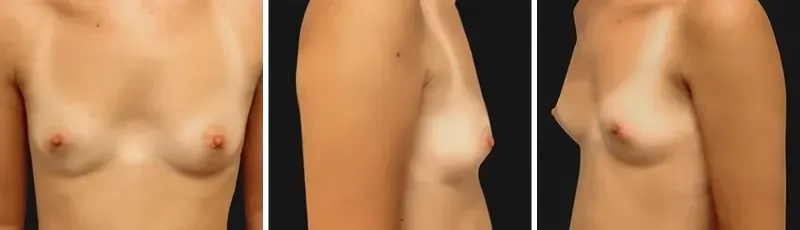
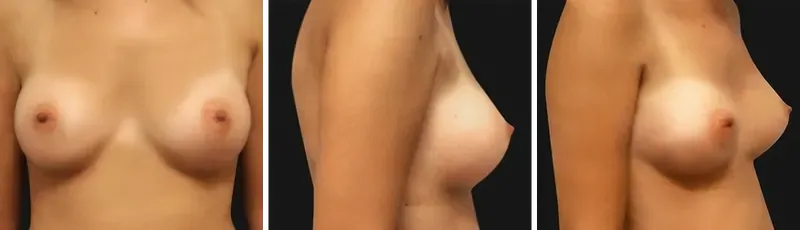
Clinical photographs
These images show surgical results and include nudity. They are for adults considering surgery.
Implant registry, breast screening and breastfeeding
Implants bring a few long-term responsibilities worth knowing in advance.
- Breast and Cosmetic Implant Registry (BCIR). Details of your implants are recorded on the national registry run by NHS England, so you can be traced if a safety issue arises with a particular implant. In England and Scotland your consent is not needed for this; you can ask to see your record. Keep your implant card, which lists the manufacturer, model, size and batch.
- Breast screening and mammograms. Women with implants can take part in the NHS Breast Screening Programme. Tell the radiographer about your implants: extra views are taken because X-rays cannot see through an implant, and there is no current evidence that a mammogram can cause a rupture. Screening does not check the implant itself.
- Breastfeeding. Most women with implants can breastfeed. The NHS notes that implants may slightly reduce milk production, and incisions around the areola may carry a higher risk. Tell your surgeon if you plan a family.
- Reporting problems. You or your doctor can report a suspected implant problem to the MHRA through the Yellow Card scheme.
Risks and possible complications
Breast augmentation is major surgery, and implants add risks that continue for as long as you have them. Your surgeon will explain how each applies to you before you consent.
- Bleeding or haematoma, which may need a return to theatre
- Infection, which occasionally means the implant has to be removed
- Blood clots: deep vein thrombosis (DVT) or pulmonary embolism
- Reactions or complications related to the anaesthetic
- Capsular contracture: tightening of the scar capsule, making the breast firm, painful or misshapen
- Implant rupture or gel leak, which is often silent and found on a scan
- Rippling, wrinkling or visible implant edges, especially with thin tissue
- Implant malposition, rotation of anatomical implants or a “double bubble” at the fold
- Animation deformity when the implant is behind the muscle
- Changes in nipple or breast sensation, occasionally permanent
- Asymmetry, or a size or shape that differs from what you hoped for
- Thickened, raised or stretched scars
- Seroma (fluid around the implant), including late seroma, which always needs assessment
- Rare implant-associated cancers: BIA-ALCL and, very rarely, other lymphomas or squamous cell carcinoma (BIA-SCC)
How common are problems? BAPRAS patient information gives bleeding and infection rates of less than 1% each, and capsular contracture severe enough to notice in up to 10% of patients over time. The chance of further surgery is about 1% a year.
BIA-ALCL. Breast implant-associated anaplastic large cell lymphoma is a rare cancer of the immune system that develops in the fluid or scar capsule around an implant, not in the breast tissue itself. The MHRA reports a UK rate of around 1 in 12,187 breast implants and tissue expanders sold, with almost all cases linked to textured implants. Symptoms appear on average 7–10 years after implantation, most often as fairly rapid swelling of one breast, usually without pain. It is usually curable when found early, and the MHRA does not advise removing implants without symptoms.
Breast implant illness. Some people with implants report symptoms such as fatigue, “brain fog” and joint pain. The MHRA states that it is not currently known whether there is a link with implants, and it continues to monitor reports. Our implant removal page explains the evidence.
How we reduce risk: full medical assessment, an implant that fits your tissue, strict sterile technique, clot prevention and structured follow-up. The MHRA’s breast augmentation risk awareness tool is a useful checklist to bring to your consultation.
Alternatives to consider
Choosing not to have surgery is always a reasonable decision. Other options include:
- Fat transfer to the breast: your own fat, taken by liposuction, is injected into the breast. It avoids an implant, but the increase is modest, some fat does not survive and more than one session may be needed.
- Breast lift (mastopexy): if sagging is the main concern, a lift reshapes and raises the breast. It can be combined with an implant when volume is also low.
- Non-surgical options: well-fitted or padded bras and prostheses carry no surgical risk. Injectable breast fillers are not recommended; the UK government has proposed classing them as high-risk procedures.
How much does breast augmentation cost?
Breast augmentation at iQonic costs from £9,750. Preserve by Motiva® starts from £9,850 and Mia Femtech® from £11,950.
Your final price depends on the technique, the implants you choose, the hospital, whether a lift or other procedure is combined, and your individual aftercare plan. You receive a written quote after consultation, valid for three months. Your deposit is non-refundable once the 14-day reflection period has passed.
The NHS website quotes typical UK costs of around £3,500 to £8,000. When comparing quotes, check whether they include consultations with the operating surgeon, the anaesthetist, hospital stay, implants and warranty, garments, follow-up and the cost of treating complications. Our breast augmentation cost guide explains what drives prices, and our guide to choosing a cosmetic surgeon covers the questions worth asking.
Cosmetic breast augmentation is not usually available on the NHS. Finance is available through our credit partner; see pricing and finance for details. Budget, too, for future implant surgery.
Your surgeon
Your consultation is with the consultant who would operate. Check any surgeon on the GMC register.
What happens next
Consultation
Start with a free virtual consultation with a patient advisor if you like, then meet your surgeon at 15 Harley Street (£100) for a 45-minute consultation: an examination, options, risks, and a written plan and quote valid for three months. You are welcome to bring a partner, friend or family member.
At least 14 days to reflect
Take time to read, ask questions and decide. We never shorten it.
Consent, when you are ready
If you go ahead, you confirm the plan and give consent with your operating surgeon. Further consultations are always available before you decide.
Surgery and aftercare
At a CQC-registered hospital, with planned follow-up reviews, then free yearly check-ups and a 10-year health check. Our nurse is available evenings and weekends by call or text. Your journey in full
Questions people ask
How much does a breast augmentation cost in London?
At iQonic, breast augmentation starts from £9,750, Preserve by Motiva® from £9,850 and Mia Femtech® from £11,950. Your exact price is confirmed in a written quote after consultation.
How long is recovery after breast augmentation?
Most people take 1–2 weeks off desk work, drive after 1–2 weeks and return to full exercise at around 6 weeks. The breasts take 3–6 months to settle. Recovery is usually easier when the implant sits in front of the muscle.
How long do breast implants last?
Implants are not lifetime devices. The NHS advises they may need replacing at around 10 years, and the chance of further surgery is roughly 1% a year. Many women keep their implants for longer without problems, and routine replacement is not needed if nothing has changed.
How do I choose the right implant size?
Your surgeon measures your breast width, tissue thickness and skin stretch, which sets a sensible range of volumes. Within that range, a 3D preview and sizers help you choose.
Is it better to put implants over or under the muscle?
Neither is right for everyone. Over the muscle usually means an easier recovery but needs enough tissue to cover the implant. Under the muscle (dual-plane) gives more cover in slim women, with a more uncomfortable recovery and possible animation deformity.
Where will my breast augmentation scar be?
Most often in the crease under the breast, where it is hidden by the fold and underwear. Alternatives are the edge of the areola or the armpit, which is the route used for Mia Femtech®. Scars are pink at first and fade over 12–18 months.
Can I breastfeed with breast implants?
Most women with implants can breastfeed, although the NHS notes implants may slightly reduce milk production. If you plan a family, tell your surgeon, as it can influence the incision and timing.
Can I have a mammogram with breast implants?
Yes. Tell the radiographer that you have implants; they will take extra views because X-rays cannot see through the implant. The NHS Breast Screening Programme states there is no current evidence that a mammogram can cause an implant to rupture.
Does breast augmentation hurt?
You are asleep during traditional surgery. Afterwards most people describe tightness and pressure rather than sharp pain, strongest in the first 2–3 days and controlled with prescribed pain relief. Implants behind the muscle usually cause more discomfort.
What is BIA-ALCL, and should I be worried?
BIA-ALCL is a rare lymphoma that forms in the scar capsule around an implant, mostly linked to textured implants. The MHRA reports a UK rate of around 1 in 12,187 breast implants and tissue expanders sold. It usually shows as swelling of one breast, often without pain, years later, and should be checked promptly; it is usually curable when found early.
Will I need a breast lift as well as implants?
If your nipple sits at or below the breast fold, an implant alone may not give the shape you want, and a lift may be recommended at the same time or as a separate stage. Your surgeon will assess this at consultation.
Further reading
- Mia Femtech® vs Preserve by Motiva® vs traditional Guide
- Breast augmentation cost UK Guide
- Plan your breast augmentation recovery by date Tool
- Breast augmentation recovery week by week Journal
- Comprehensive guide to breast enhancement surgery Journal
- Essential tips for smooth breast augmentation recovery Journal
References and further reading
- NHS — Breast enlargement (implants)
- BAPRAS — Your guide to breast augmentation
- MHRA — Breast implant associated anaplastic large cell lymphoma (BIA-ALCL)
- MHRA — Cosmetic breast augmentation risk awareness tool
- MHRA — Symptoms sometimes referred to as breast implant illness
- NHS England — Breast and Cosmetic Implant Registry
- NHS England — Breast implants and breast screening
- BAAPS — Breast augmentation